Nature
 PUBLISHED
 13
13


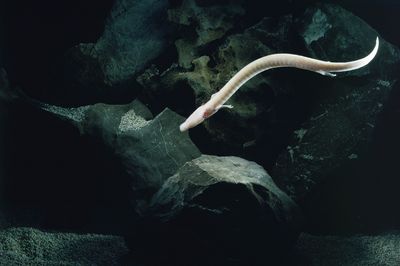


When a team of scientists studied a group of olms in a Balkan cave, they were hoping to reveal new information about how these fascinating amphibians behave outside of the lab. They weren’t, however, expecting to find they were mind-blowingly lazy, with some individuals not moving from a single spot for years and years.
Olms are rare, cave-dwelling salamanders native to Europe. They’re found exclusively in the subterranean waterways of the Balkans, particularly along the Adriatic coast in northeastern Italy, Slovenia, Croatia, Bosnia and Herzegovina, and northern Montenegro.
With pale skin, a slinky body, and puny limbs, the olm resembles a ghostly, aquatic serpent that spends its life in dark, water-filled caverns. In local folklore, these elusive creatures are said to be the offspring of mighty dragons that dwell beneath the Earth’s crust, mysteriously surfacing during periods of heavy rain.
Living most of their lives in complete darkness, olm have evolved to lose their eyesight. Their eyes are underdeveloped and covered by skin, rendering them effectively blind. To compensate, they’re equipped with highly sensitive chemoreceptors that allow them to detect tiny traces of organic matter in the water, allowing them to locate prey like insect larvae, shrimp, bugs, and small snails.
If no food is around, it's not a big deal, since they can go without a meal for years. This remarkable ability to endure long periods without nourishment means they don’t need to waste energy searching for food – as you can see in their incredibly sluggish behavior.
Between 2010 and 2018, three researchers from Eötvös Loránd University in Hungary and the Devon Karst Research Society in the UK tagged and monitored a total of 26 individuals living in a spring-filled cave in the Gorica district of Bosnia and Herzegovina.
They were truly astonished at how immobile these creatures were. As reported in the Journal of Zoology in 2020, they only moved around 5 meters (16 feet) in a year on average, but some barely moved more than a few meters over several years. In one case, they found an olm that did not move an inch in 2,569 days – that’s seven damn years.
This behavior contrasts sharply with observations in laboratory settings, where most scientific knowledge about the species has stemmed from. In captivity, they often move, hide, and even display social behavior. But in the wild, these cave-dwellers seem to prefer a far more laid-back, almost motionless lifestyle.
The researchers propose that this sedentary behavior is tied to the species’ energy-conserving lifestyle. The species has a long lifespan (up to 100 years), rarely reproduces (once every 12.5 years or so), and can survive on very little food. As such, there’s simply no need to rush and waste precious energy.
However, there’s a chance this group of olms might not necessarily be representative of the wider species. While the population studied appears healthy, analysis of the cave's olms revealed they had almost no genetic variation, which could imply that the idle behavior is only specific to this population.
Nevertheless, the research clearly shows how much more can be learned by studying organisms in their natural environment rather than the unnatural confines of a stuffy lab.