Space and Physics
 PUBLISHED




Here on Earth, though gravity varies slightly based on proximity to mass and altitude, we are used to a comfortable 1g of gravity. Animals have evolved in this environment, with this constant force shaping our biology, whether you are a tiny unicellular organism, or a human.
Researchers, including on the International Space Station (ISS) have subjected humans and animals to microgravity environments. But what would happen to us if we were exposed to gravity levels far higher than we typically experience here on Earth? In a new experiment, scientists from UC Riverside (UCR) simulated a high-gravity environment for fruit flies, and found some unexpected effects on their behavior.
Of course, it's pretty difficult to generate intense gravity in the old fashioned way. Were we to take a fruit fly to Jupiter's clouds, it would only experience around 2.528g, lower gravity than the researchers were interested in.
Thankfully, we don't have to fly close to the Sun, the largest source of mass in the Solar System, in order to simulate hypergravity. As Einstein taught us, the effects of gravity are locally indistinguishable from the effects of being accelerated. If you were suddenly to wake up in a spacecraft with no windows and experiencing 1g of acceleration (and assuming you don't know how expensive and heavy fuel is) you would have no way of determining whether you were accelerating at that rate in space, or sat on the Earth like chumps in a slightly cruel UK Channel 4 reality show.
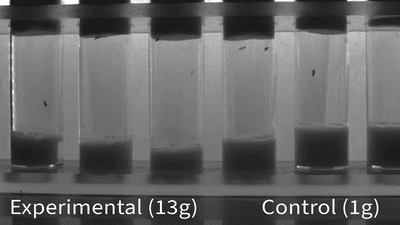
As such, the team was able to simulate a hypergravity environment for the flies, using a custom-built centrifuge to subject them to 4g, 7g, 10g, and a whopping 13g.
“The centrifuge is like a merry-go-round,” first author Sushmita Arumugam Amogh explained in a statement. “The faster you go, the more you feel pulled outward. That’s hypergravity.”
The experiment was relatively simple in design. The team subjected common fruit flies to a range of accelerations, and monitored their activity during and after being subjected to hypergravity. Fruit flies were chosen partly due to their short lifespans, allowing the team to monitor their behavior over their lives, and over multiple generations. In particular, they measured the flies' climbing behavior, or negative geotaxis, an innate behavior in which they tend to move upwards and against the direction gravity is acting upon them.
With all that extra work needed in order to move around, you might expect that the flies would attempt to conserve energy in higher gravity environments. Whilst this was true eventually, at first their activity actually increased.
“When flies experienced four times Earth’s gravity, or 4G, for 24 hours, they became hyperactive,” Ysabel Giraldo, UCR assistant professor of entomology and coauthor on the paper, added. “But at higher levels of 7G, 10G, and 13G, the pattern reversed: Instead of becoming hyperactive, the flies became less active, and they didn’t climb as much.”
When the flies were returned to normal gravity conditions, they remained in their high/low activity states for quite some time, before eventually returning to baseline activity levels. The team believes that these are energy tradeoffs, with the 4g condition pushing the flies into more activity, whilst at higher gravity levels energy conservation becomes more crucial.
Adding to this evidence, female flies were found to produce fewer eggs under higher-gravity conditions, prioritizing maintenance over reproduction.
“We believe what we’re seeing is that gravity feeds directly into the brain’s decision-making around energy use and movement,” Arumugam Amogh added. “It helps determine whether to act or conserve energy.”
“This consistent pattern suggests a potential plateauing effect at higher gravity levels, possibly reflecting physiological mechanisms that are not yet fully understood. Given previous findings that indicate an increase in metabolism in flies and a reduction in food intake in mice after hypergravity exposure, a decrease in locomotor activity with increasing gravity-level exposure may suggest a redistribution of available energy between maintenance and locomotion,” the team adds in their paper.
In one part of the experiment, flies were raised from eggs in hypergravity, lived out their lives, and reproduced for 10 generations in this environment. The team saw the same pattern emerge, with fruit flies becoming more active at 4g, and more lethargic at increased accelerations. However, when returned to 1g these flies did not recover as well as those exposed for shorter periods.
“Together, these findings indicate that flies reared in chronic hypergravity show persistent locomotor impairments at 1 g, with no evidence of recovery or further decline across generations,” the team explains.
Perhaps most surprisingly, the flies were able to survive these high gravity levels quite well, including those in later experiments which were subjected to it for the entirety of their lifespans, suggesting that animals pushed to these extremes can still find ways to cope with it, and eventually recover when returned to normal conditions.
Whilst no crewed mission (by fly or human) to a gas giant or distant super-Earth is planned in the near future, it's good to know that biological systems are adaptable, and capable of withstanding such uncomfortable conditions.
The study is published in the Journal of Experimental Biology.