Nature
 PUBLISHED
 1
1


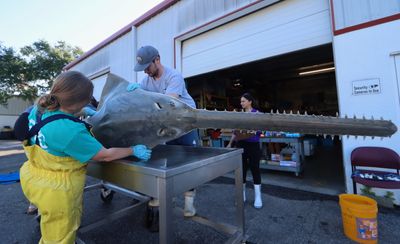


The curious case of Florida's sawfish is continuing to evade explanation. Researchers have been working hard to find the reason why sawfish in the Florida Keys are erratically spinning around and dying en-masse, but their tests have yet to uncover a culprit.
Since the fall of 2023, the Florida Fish and Wildlife Conservation Commission (FWC) has collected hundreds of reports of smalltooth sawfish (Pristis pectinata) in the Florida Keys exhibiting “abnormal fish behavior”, including thrashing around and swirling in circles. As of late May 2024, they’ve documented 50 sawfish deaths too.
The FWC launched a first-of-its-kind emergency response effort to prevent additional deaths in March 2024. This involved extensive testing of 250 chemicals in the water, as well as sampling of fish tissue from necropsies.
So far, nothing unusual has been found, deepening the mystery.
All tested chemicals in the water were either not detected or were below any biological thresholds, with most being below minimum detection limits, while the fish necropsy data so far has not shown any apparent signs of a communicable pathogen or a bacterial infection.

The FWC also doesn’t believe the water’s dissolved oxygen levels, salinity, pH, or temperature are a factor.
One of the main suspects the FWC had initially highlighted was toxic red tide, a harmful algal bloom that produces toxins known to cause neurological problems for fish and other animals. However, their tests have suggested this factor isn't at play.
However, other harmful algal species and their associated toxins have been observed in samples of the water, seabed, and fish tissue. While it's a promising avenue to explore, the FWC stressed that “more work is needed to determine if this is the cause of the unusual behavior.”
Likewise, tests for heavy metals in the water, as well as blood and tissue samples of the sawfish, are still under analysis and pending results.
With their long, flat snout that is lined with sharp transverse teeth, sawfish look like a half-shark and half-chainsaw. Their unusual saw snouts are used to hunt; along with helping them dig around sedimented seabeds, it also emits an electrical field that helps them find prey. Taxonomically, they belong to the subclass Elasmobranchii alongside sharks, rays, and skates.
There are at least five species of sawfish, all of which are critically endangered with extinction – a fact that makes the plight of Florida’s smalltooth sawfish all the more pressing.