Space and Physics
 PUBLISHED




In a delightfully nerdy move, a group of scientists having a games night and eating pasta have published a paper on the physics of how their food was cooked.
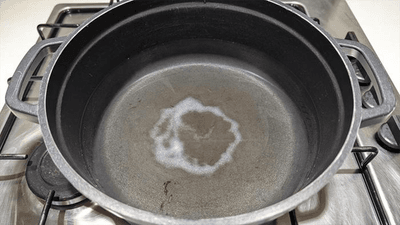
The group of scientists, from the University of Twente in the Netherlands and the French National Institute for Agriculture, Food, and Environment (INRAE), were enjoying food and board games, when they began discussing salt rings left behind at the bottom of pans after boiling pasta with added salt. Naturally, this led them to wonder how they could make the most beautiful ring of salt, and the variables that would involve.
“By the end of our meal, we’d sketched an experimental protocol and written a succession of experiments we wanted to try on my youngest son’s small whiteboard,” Mathieu Souzy, lead author on the paper, said in a statement. “It was a great overall experience, because we soon realized our simple observation of daily life conceals a rich variety of physical mechanisms!”
The team found that when salt is dropped into the pan and settles at the bottom, courtesy of our old friend and deadly foe gravity, it disrupts the flow of the water and creates drag behind it.
“If a large number of particles are released at the same time, neighboring particles experience this flow perturbation generated by all surrounding particles,” Souzy explained. “It causes sedimenting (falling) particles to be progressively shifted horizontally, which leads to an expanding circular distribution of the particles.”
When a large amount of salt is poured into the pan, it forms a circle at the bottom, before the perturbed flow causes the salt to radiate outwards, leaving a hole in the middle. If the salt is dropped from a greater height, however, the particles radiate outwards as they fall through the water for longer.
As a result, the cloud of salt radiates out until there is plenty of space between each individual grain. When they are spaced this far apart, they are far enough away from their neighboring salt grains that they are no longer affected by their altered flow. From here, gravity does its work, and they fall down to make a (fairly) neat circular deposit.
“These are the main physical ingredients, and despite its apparent simplicity, this phenomenon encompasses a wide range of physical concepts such as sedimentation, non-creeping flow, long-range interactions between multiple bodies, and wake entrainment,” Souzy added. “Things get even more interesting once you realize larger particles are more radially shifted than small ones, which means you can sort particles by size just by dropping them into a water tank!”
The paper is published in Physics of Fluids.