Space and Physics




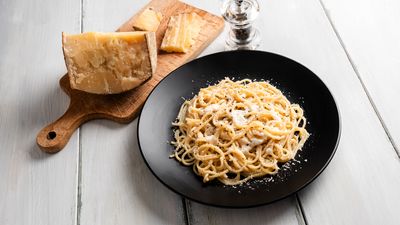


There’s a recipe from Rome and its surroundings that is deceptively simple and sinfully delicious. It has three ingredients (plus a secret one): Pasta, pecorino cheese, and pepper. Together, these ingredients make Pasta cacio e pepe, a delicious, creamy dish that is truly a marvel of Italian cuisine.
However, as we said, it is deceptively simple. To obtain the delicious creaminess, the pecorino and pepper are mixed with the water from the pasta, which delivers the fourth ingredient: starch. But as many people who have attempted to make cacio e pepe will attest, this step can go wildly wrong.
Asking my mother – whose cacio e pepe is superb – how would I know the right amount of water to add to the cheese, she replied that I will know when it's right. I’m assuming that her expectation is that I can enter the Avatar state and be guided by generations of Italian grandmothers in balancing pecorino, water, and starch. Somehow I can do it, evidence that cooking is an art - although I believe that at least for cacio e pepe, it is a science too.
An international group of physicists agreed, investigated the intricacies of the recipe, and realized the secret to the creaminess is in the balance between the starch and the cheese, sharing their results in a preprint paper that has yet to undergo peer review. Too much starch and the sauce hardens as it cools. They established that if the starch content is more than 4 percent of cheese weight, you get that hardened sauce. So the water shouldn’t be too starchy – but you have a different kind of problem on the other end.
The team found that if the quantity of starch is less than 1 percent of the cheese weight, you risk something even worse than the hardened sauce. The cheese will form clumps described by the researchers as the “mozzarella phase”. Basically, the cheese is suspended in water, resulting from extreme protein aggregation on heating.
So, if you would like to try your hand at a cacio e pepe – without needing the knowledge of dozens of Italian nonne – you have two options. Chefs tend to use a couple of tricks to help make the emulsion happen. As your pasta cooks (tonnarelli, spaghetti, or rigatoni), you toast some of the pepper in a pan with some oil (that is a way to make it easier for yourself), adding some pasta water and making it evaporate, thus concentrating the starch. Though it is still guesswork if you have enough.
Before the pasta is fully cooked, take it out of the water and put it in the pan. This is the crucial mantecatura step, fundamental in Italian cuisine. Add the pecorino, and a little more pasta water, finishing cooking the pasta in the pan, stirring it to get the creaminess.
If getting to the right consistency is still too difficult with that method, the scientists suggest preparing starchy water on the side by mixing some potato or corn starch and water (4 grams in 40 grams of water for 160 grams of pecorino), that will be used with the pepper and the pecorino. Make sure that the water is hot.
The study is published in Physics of Fluids.


 1
1