Technology
 PUBLISHED
 4
4


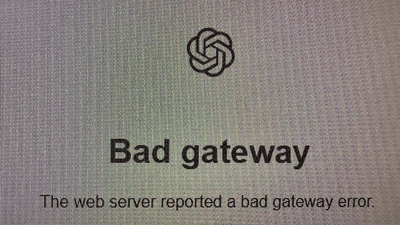


A scientist has written a piece for the esteemed journal Nature explaining how he lost two years' worth of research when he pressed the wrong button on ChatGPT.
Marcel Bucher, professor of plant sciences at the University of Cologne in Germany, admitted in the piece that he had come to rely on OpenAI's large language model (LLM) over the last few years. According to the professor, he used it for everything from writing emails and analyzing student responses, to revising publications, planning lectures, and preparing grant applications. He knew that these chatbots "hallucinate" – or place words in a pleasing order that seems plausible, but is not true – but said that he relied upon the apparently stable workspace that the LLM provided.
That changed in August 2025, when he played around with his data consent options in the LLM.
"I temporarily disabled the ‘data consent’ option because I wanted to see whether I would still have access to all of the model’s functions if I did not provide OpenAI with my data," Bucher wrote in his Nature piece. "At that moment, all of my chats were permanently deleted and the project folders were emptied – two years of carefully structured academic work disappeared. No warning appeared. There was no undo option. Just a blank page."
Bucher didn't think this was right, and attempted to recover his work by changing browsers, clearing his cache, and reinstalling the app, but to no avail. Having spent several years being reasonably happy with artificial intelligence (AI) responses, Bucher now sought some human help.
"When I contacted OpenAI’s support, the first responses came from an AI agent," he added. "Only after repeated enquiries did a human employee respond, but the answer remained the same: the data were permanently lost and could not be recovered."
OpenAI explained to Bucher that the issue was actually a privacy feature. Once a user chooses to deactivate sharing their data, their chat history is deleted and cannot be recovered.
With many people concerned about AI plagiarizing the work of the people it is trained on, the piece did not draw much sympathy online.
"Maybe next time, actually do the work you are paid to do *yourself*, instead of outsourcing it to the climate-killing, suicide-encouraging plagiarism machine," one BlueSky user wrote, while another joked "All My Apes Gone, academia edition."
"I would be so angry if the professor of a course I needed for my future career was doing all his teaching and grant writing and shit with chatgpt. so embarrassing. Jesus Christ," physicist and popular science communicator Angela Collier added. "How did you get a PhD if you need help writing an email? You're having 'conversations' with a chatbox?"
While we aren't going to solve the AI debate here, the case does highlight the issue of who owns your data, and the importance of backing up your work. As well as this, the systems are still evolving as they go. OpenAI executive Sarah Friar recently said that the company will look into taking a cut of profits which come from breakthroughs made by researchers using ChatGPT, attempting to mitigate the company's well-documented losses, which potentially amount to $12 billion per quarter.
"As intelligence moves into scientific research, drug discovery, energy systems, and financial modeling, new economic models will emerge," OpenAI explains on their blog. "Licensing, IP-based agreements, and outcome-based pricing will share in the value created. That is how the internet evolved. Intelligence will follow the same path."
Bucher claims that university staff are increasingly being asked to incorporate AI into their workflow, with individuals using it for writing and teaching. But he says that the product is not good enough for academic work, and their focus on reliability and accountability.
"If a single click can irrevocably delete years of work, ChatGPT cannot, in my opinion and on the basis of my experience, be considered completely safe for professional use," he added.
The full article is published in Nature.