Space and Physics
 PUBLISHED



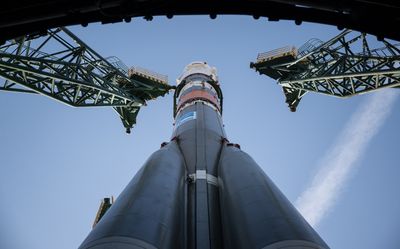


When you are about to launch into space, you want to make sure everything is GO – all the more so if you have people on that rocket. Yesterday’s Soyuz launch toward the International Space Station was scrubbed just 21 seconds before lift-off.
The abort was triggered by an automated system, the cause being a low voltage reading in the Soyuz rocket's electrical system. The window for the next launch is tomorrow, and both Roscosmos and NASA will want to know if what happened yesterday will affect the next launch attempt.
“The next available launch opportunity is Saturday, March 23, pending completion of State Commission review for the Roscosmos launch. More information will be provided as available,” NASA said in a statement.
Soyuz MS-25 carries to the International Space Station NASA astronaut Tracy C. Dyson, Roscosmos cosmonaut Oleg Novitskiy, and spaceflight participant Marina Vasilevskaya of Belarus. Dyson is going to spend six months aboard the space station as part of the Expedition 71 crew. Marina Vasilevskaya, who will become the first Belarusian woman in space, will be in orbit for 12 days and return with a member of Expedition 70 crew as well as Novitskiy.
Soyuz rockets are extremely reliable and an abort before launch is very rare. Yesterday’s event reminded us of the in-flight abort of 2018, when NASA astronaut Nick Hague and cosmonaut Alexey Ovchinin’s Soyuz was jettisoned from its rocket and forced to do an emergency landing.
Once launched, the Soyuz will complete two orbits and dock after a few hours with the Prichal module on the Russian side of the space station. They will be met by NASA astronauts Loral O’Hara, Matthew Dominick, Mike Barratt, and Jeanette Epps, as well as Roscosmos cosmonauts Oleg Kononenko, Nikolai Chub, and Alexander Grebenkin. Loral O’Hara will hitch a ride and come back with Vasilevskaya and Novitskiy in early April.