


 Technology
 PUBLISHED


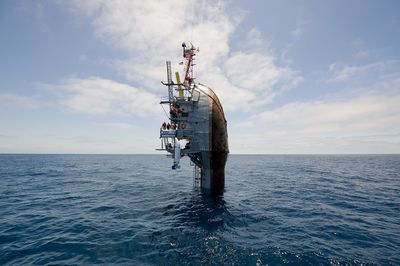


Update 23/10/24: It recently came to light that R/P FLIP has been saved from the scrapheap thanks to efforts from underwater habitat designers DEEP, who plan to refit and modernize the platform so that it can continue to be used for research.
R/P FLIP, the FLoating Instrument Platform, was a true one-of-a-kind, but it now lies in pieces at a undisclosed scrapyard.
Measuring 108 meters (355 feet) long, FLIP was an oceanic research platform designed to be towed out to sea horizontally, just like any conventional seafaring vessel. Upon command, it would be partially flooded and flipped by 90 degrees, allowing it to stand vertically in the water with over 90 meters (300 feet) of its body submerged.
As you can see in the video of its flipping below, which features some fabulously 80s "muzak," it pulls off this incredible maneuver in just 20 minutes with its crew of hardy scientists onboard.
The giant upright instrument was developed in the post-war era by researchers at Scripps' Marine Physical Laboratory and operated by Scripps Oceanography on behalf of the US Navy.
Its maiden flip was carried out on July 23, 1962, in a quiet fjord in Washington State. After proving its worth in a series of tests, it was towed to San Diego to start operations in September 1962. The axis-changing platform spent much of its working life in the Pacific, venturing as far as Hawai'i, but it even had one deployment in the Atlantic.
FLIP was used for over 60 years to gather vital observations about oceanic and atmospheric phenomena. One of its specialties was acoustic research, uncovering the many ways in which sound waves are influenced by variations in the ocean, such as changes in temperature or salinity. It even helped scientists learn about the depths to which whales dive and the properties of the Earth's ever-changing crust.
Like many great things, FLIP fell victim to government spending cuts in the wake of COVID-19 and the ensuing global economic downturn. Following some tough financial decisions, the US Navy pulled the plug on the platform.
“It would cost about $8 million to make FLIP useable for another five or 10 years, but that funding could be better used elsewhere. We came up with lots of creative ideas, but there wasn’t enough inertia or funding to keep it going,” Rob Sparrock, a Program Officer at the U.S. Navy’s Office of Naval Research, said in 2021, according to Sea Power Magazine.
Sparrock added that he hoped FLIP would be put on display in a museum setting, given its scientific and engineering significance. However, it was ultimately scrapped. In August 2023, FLIP made its final journey towards a dismantling and recycling facility where it was taken to pieces.
“R/P FLIP has existed for more than half the length of the institution’s entire history,” Scripps Oceanography Director Margaret Leinen said in a statement in 2023 about its retirement.
“It was an engineering marvel constructed during an important phase of new technology for ocean exploration following World War II. The many discoveries from FLIP help set the stage for ongoing cutting-edge science to understand our ocean,” added Leinen.
RIP FLIP. Gone, but not forgotten.



 1
1