Nature
 PUBLISHED
 2
2


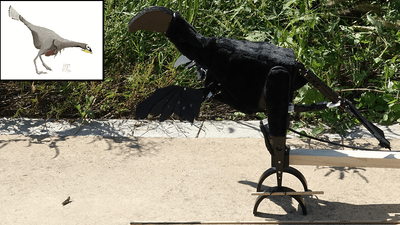


While T. rex and other large ancient predators had the advantage of size and frankly enormous teeth when it came to intimidating their prey, smaller dinosaurs didn’t have quite the same arsenal of claws and fangs to rely on. Instead, a new paper has suggested that to source their prey, these small feathered dinos used their wings to flush other species out of hiding. The team even recreated a robotic dinosaur to test their theory.
Lots of small non-avian dinosaurs possessed feathers, but one special feather type, known as pennaceous, can be seen in only one group dubbed the Pennaraptora. These feathers were present on their proto-wings (primitive wings that are too small for powered flight) and on their tails, often colored with contrasting patterns. While the function of these wings is unknown, the team thinks that displaying their plumage could have been used to help flush prey species out of their hiding places, making them easier to hunt.
The dinosaurs would have been insectivores and omnivores, driving creatures like insects out to eat. This behavior can still be seen in living bird species, such as the greater roadrunner (Geococcyx californianus) and the northern mockingbird (Mimus polyglottos). Plumage displays trigger the prey item out of hiding, allowing the animal to then pursue it and attempt to capture and consume it.
To test the theory, the team developed Robopteryx, a robotic dinosaur with proto-wings. The robot was based on the pennaraptoran dinosaur Caudipteryx, which lived roughly 124 million years ago and was thought to be around the same size as a peacock. The team then evaluated the escape behaviors of grasshoppers as a response to the robot's wing display, using this particular group of insects as they belong to the order Orthoptera, which also existed 124 million years ago.
Robopteryx was used in several sequences imitating different so-called flush–pursuit displays. Included in these displays were moments when the proto-wings were spread wide, the tail was raised and then the wings were folded back and the tail lowered.
The results showed that 93 percent of tested grasshoppers fled when the proto-wings were used by the robot, compared to only 47 percent when the wings were not used in the display. There was also a significant association between the wings having white patches and the tail having feathers and the chance that the grasshoppers would flee.
Overall the team believes this could offer one explanation for how pennaceous feathers on proto-wings and tails were used and why they might have begun to evolve like this in dinosaurs.
The study is published in Scientific Reports.