Nature
 PUBLISHED




The minerals that lie deep beneath our feet hold all sorts of secrets about our planet, like the superdeep diamonds that tell us about the formation of continents. But there’s one particularly rare, buried mineral you may well have never heard of, and it too has uncovered some mysteries. Its name? Ringwoodite.
What is ringwoodite?
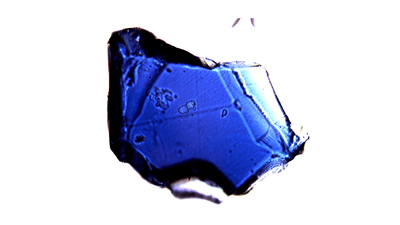
Ringwoodite was first discovered back in 1969 in a fragment of the Tenham meteorite, a space rock that took a fancy to Australia. The deep blue mineral was named after Australian geophysicist and geochemist Ted Ringwood, who had predicted that its structure might exist.
Speaking of structure, ringwoodite is a member of the spinels, a group of minerals that crystallize in the shape of a cube. It’s also a high-pressure form of the mineral olivine – both are magnesium silicates, but only olivine has some iron thrown in for good measure.
Trapped in a diamond
It’s not just a pretty blue face. As it turns out, ringwoodite is excellent at storing water – the oxygen and hydrogen atoms that make up the liquid of life can take up the place of magnesium atoms and oxides within the mineral, bundled up as hydroxyl.
"The ringwoodite is like a sponge, soaking up water. There is something very special about the crystal structure of ringwoodite that allows it to attract hydrogen and trap water," explained geophysicist Steve Jacobsen in a statement.
So, when the first ever terrestrial rock sample of ringwoodite was confirmed within a tiny “ultradeep” diamond back in 2014, scientists got pretty excited. These superdeep diamonds often form within what’s known as the transition zone, the region within the Earth separating the upper and lower mantle that’s about 410 to 660 kilometers below the surface.
“These high-pressure diamonds give you a window into the deep Earth,” said Graham Pearson, lead author of the study examining the diamond, speaking to Nature News. And not only did that window confirm the long-held theory that ringwoodite existed as a major component of the transition zone, it also gave direct evidence that water was present deep below our feet.
Water world
However, there’s not some giant ocean hidden underground (sorry not sorry, Hollow Earth enthusiasts). As mentioned above, it’s a case of hydroxyl being stored within the mineral – it’s more like a crystal reservoir of potential water, which sounds like a fairly delightful place to be if it were not for, you know, being deep underground.
But just how much “water” is in the transition zone? Another 2014 study suggests it could be quite a lot.
Using seismic wave data from over 500 earthquakes, researchers from Northwestern University and the University of New Mexico examined the speed of the waves at different depths to figure of what types of rocks the waves were traveling through. From this, they added further evidence that ringwoodite was indeed present in the transition zone.
According to their results, this would mean that even if it only made up 1 percent of the rock in the mantle, the total amount of ringwoodite in this region could hold three times the amount of water found in Earth’s oceans.
The authors also found evidence that Earth’s water cycle is more than just what happens on the surface. "If there is a substantial amount of H2O in the transition zone, then some melting should take place in areas where there is flow into the lower mantle," study author and seismologist Brandon Schmandt explained in a statement, "and that is consistent with what we found."
"I think we are finally seeing evidence for a whole-Earth water cycle, which may help explain the vast amount of liquid water on the surface of our habitable planet," added Jacobsen. "Scientists have been looking for this missing deep water for decades."
Not a bad day’s work for ringwoodite, it seems.