Nature
 PUBLISHED


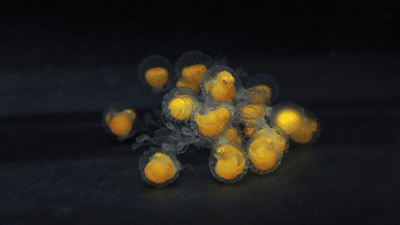


“Imagine dipping a toad in some brightly coloured paint, telling it a sad story, and forcing it to wear gloves two sizes too big.” That’s a description of the world’s rarest fish that appears on the Handfish Conservation Project’s website, and they really hit the nail on the head. Arguably the only thing more ridiculous than a handfish are its babies, but these perplexed little orbs recently wowed the judges at the Beaker Street Science Photography Prize.
The Judge’s Choice Winner was awarded to Andrea Williamson for her image of some of the rarest fish in the world. Though they be comical, these babies marked a turning point in the future of red handfish thanks to a breeding program that welcomed 21 hatchlings in 2023.
“The successful development of Red Handfish (Thymichthys politus) embryos in captivity signifies a significant milestone in conservation efforts led by the Red Handfish Conservation Team at the Institute for Marine and Antarctic Studies,” Williamson said in a statement. “It demonstrates the dedication and expertise of the conservation team and offers hope for the future of this elusive species.”
“Given the precarious situation of the Red Handfish population, with fewer than 100 adults remaining in just two small reef patches in southeastern Tasmania, efforts to preserve them in captivity are vital for their long-term survival.”
It’s not surprising, then, that Williamson’s winning image was met with great praise in the “Shows a biological concept” category.
“I especially enjoyed this image due to the incredible detail of the eggs and the structure of the image was spot on,” said Cam Blake, competition judge and photographer in a statement sent to IFLScience. “A very hard shot to capture so wonderfully sharp and composed very nicely too. And along with the fact that these are an endangered species made this shot even more important. Well done and congratulations.”
Beaker Street’s annual Science Photography Prize celebrates the extraordinary part of the world that is Tasmania, which they say “is teeming with science and scientists.” So, what other scientific stories has the competition scooped over the years? Let’s take a look.
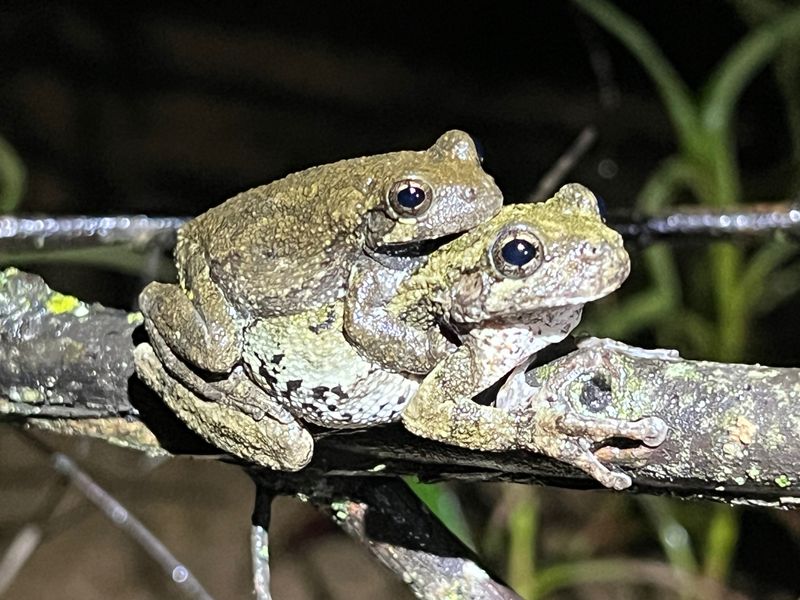
People’s Choice Winner 2024 – Toby Schrapel

“Most of you will already know that this is a bioluminescent mushroom, but did you know that the blue glow in the little frog’s eyes and on his body is another type of glow called biofluorescence?” said Schrapel.
“This occurs when a living organism has a chemical surface that absorbs light at one wavelength and re-emits it at another. There are many things that can fluoresce, including us. A 365 nm torch is your key to entering this magical new world full of wonderful new discoveries, all from asking just one question. ‘I wonder if it will glow?’”.
People’s Choice Winner 2023 – Anthony Davey

“This image of a Blackwood tree (Acacia melanoxylon) exhibits the natural phenomenon called “Crown Shyness”, which describes the distinct gaps between the canopies of adjacent trees,” said Davey. “It is believed to help prevent the spread of disease, parasites, insects and their larvae.”
“Scientists have been studying this since the 1920’s and many theories abound as to how it arises. The most prevalent suggests the tree’s new growth is able to discern direct sunlight from blue light and far red scattered light. The latter wavelengths are more prominent in reflected light from leaves from an adjacent tree, so being able to detect it allows the tree to arrest its growth in the direction of adjacent trees. Crown shyness may incidentally allow more light into the understorey and forest floor, enabling the growth of plants there that benefit fauna too, since these parts of the ecosystem are all connected.”
To see the full selection of remarkable winning images, check out the Beaker Street website. Finalist images are displayed at the Tasmanian Museum and Art Gallery during Beaker Street Festival each August.