Nature
 PUBLISHED


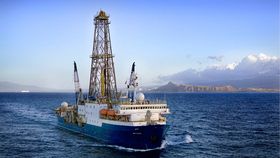


This week, 30 scientists will begin a two-month drilling expedition to understand what happens when a whole continent sinks beneath the waves. The landmass in question is called Zealandia, a submerged continent near Australia with the islands of New Zealand as the above-water part.
The expedition, which was organized by the International Ocean Discovery Program (IODP), will drill at six sites in the Tasman Sea, where the depth of the ocean ranges from 1,000 to 5,000 meters (3,300 to 16,400 feet). The goal is to collect sediments from deep beneath the seafloor. They will drill 300 to 800 meters (1,000 to 2,600 feet) into the sunken ground at each location. The sample will hopefully clarify questions regarding the region's plate tectonic processes and the Earth’s past climate.
“We’re really looking at the best place in the world to understand how plate subduction initiates,” expedition co-chief scientist Gerald Dickens, professor of Earth, environmental and planetary science at Rice University, said in a statement. “This expedition will answer a lot of lingering questions about Zealandia.”
For most of Earth’s history, Australia, Antarctica, and Zealandia were a single landmass. Then 85 million years ago, Zealandia went off on its own. Although submerged now, we know it’s a continent due to its lighter, more buoyant rocks. Oceanic plates tend to sink underneath the continental ones in a process called subduction, which changes the landscape of the continent. In South America, it formed the Andes. For Zealandia, it started an Atlantis-style cataclysm.
“Some 50 million years ago, a massive shift in plate movement happened in the Pacific Ocean,” said Jamie Allan, program director in the National Science Foundation’s Division of Ocean Sciences, which supports IODP. “It resulted in the diving of the Pacific Plate under New Zealand, the uplift of New Zealand above the waterline and the development of a new arc of volcanoes. This IODP expedition will look at the timing and causes of these changes, as well as related changes in ocean circulation patterns and ultimately Earth’s climate.”
The researchers want to understand exactly what happened in the separation between Zealandia and Australia.
It’s not just geology that intrigues the expedition team, though. Analysis of Zealandia will help refine climate models of the ancient Earth. Models struggle to explain the epoch around 50 million years ago, so the data collected from the continent should help researchers understand more.