Culture and Society
 PUBLISHED
 1
1




In 1979, two magicians walked into a study. It sounds like the start of a joke, but Project Alpha was more of a trick – a hoax, intended to investigate the scientific rigor of researchers conducting parapsychology research using, of all things, magic tricks.
Magic as a tool for science is more widespread than you might realize. We’ve used card tricks to investigate primate behavior, and misdirection to explore everything from cybercrime to the placebo effect.
James Randi's big idea
In the late 1970s, magician and parapsychology skeptic the late James Randi received letters from two young magicians: Michael Edwards and Steve Shaw (who would later become the famous mentalist, Banacheck). They were offering their services should he ever wanted help testing scientific rigor among the parapsychologists he was openly critical of.
Randi, unsure what to make of it, put their letters in a file he labeled “Alpha”, but then he had an idea. The McDonnell Laboratory for Psychical Research (AKA, the MacLab) had received half a million dollars in funding for a new body of work, and he knew just how to get in.
Project Alpha
Randi contacted the MacLab under the pretence that he had some suggestions as to how they could rigorously test for evidence of paranormal phenomena. His advice included pitfalls to avoid – pitfalls he felt had not been accounted for during tests conducted at the Stanford Research Institute involving Uri Geller (yes, the spoons man).
At the same time, Edwards and Shaw applied to become participants in the research. They were both successful and ended up being involved in the study for three years from 1979 to 1982. It’s during that window of time that the shenanigans began.
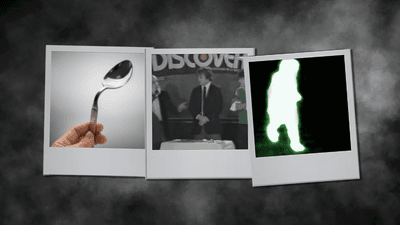
One of Randi’s tips was to ensure equipment was labeled so it couldn’t be swapped out. In the case of the spoon-bending experiment, the study opted to use paper labels attached with a string. However, Edwards and Shaw quickly found out that these were easily swapped around.
They used misdirection to distract the investigators, attempting to mind-bend spoons in one hand while secretly hand-bending other spoons under the table. Even just swapping the spoons’ labels without bending them was enough to spark psychic interest, because their weights and measurements were noted as changing from the start of the experiment to the end – something the investigators marked up as potential evidence of paranormal phenomena.
A ghostly photo
In a two-part YouTube video filmed years later, Edwards spoke of another trick in which they used a Polaroid camera to produce a ghost in a photo. In truth, they used a double exposure trick to first take a photo of Edwards' face that then appeared as a ghostly apparition (apparently not recognizable) over the sweater of another participant who was photographed during the study.
In the video, Randi notes that this could have been accounted for had the researchers taken steps to avoid the pitfall of equipment tampering. One solution could have been to take a control photograph first, ensuring that the next image produced by the camera was not influenced by previous use. Instead, the investigators continued to phone Randi with news of the psychic powers their research was uncovering.
The big reveal
In 1983 Randi, Edwards, and Shaw announced their deception during a press conference. The news was met with a mixed reaction to say the least. Some celebrated the hoax, hailing it as evidence that parapsychology experiments were poorly controlled and should be disregarded as science. Others criticized the trio's interference in what was intended to be legitimate research, and how it undermined the efforts of those involved.
It's a cautionary tale that raises interesting questions about how much scientists can trust their participants, and what steps can be taken to ensure experimental results aren't influenced by an individual's motivations or deceptions. Magic or otherwise.
For more on The Science Of Magic, join us on December 11 where you can put your questions to magician and psychologist Dr Gustav Kuhn during our YouTube watch party. Or if research into the paranormal (and why so many people believe in ghosts) is more your bag, check out our interview with Professor Chris French, an expert in the area of anomalistic psychology who focuses on non-paranormal explanations for what appear to be paranormal experiences.