Nature
 PUBLISHED


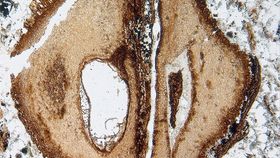


Along the rocky shores of Vancouver Island in Canada, scientists have identified the world's oldest fossilized remains of a mahogany plant, a discovery that pushes back the fossil record for the mahogany family to a time when dinosaurs still stomped the Earth.
The rest of this article is behind a paywall. Please sign in or subscribe to access the full content.Mahogany is best known as the reddish-brown timber often used to make furniture, although it actually describes a diverse flowering plant family of mostly trees and shrubs known scientifically as Meliaceae.
Reported in the American Journal of Botany, researchers analyzed a well-preserved mahogany specimen discovered just off Vancouver Island in Canada. Their research showed the specimen dated to somewhere between 72 to 79 million years ago during the Campanian stage of the Late Cretaceous, some 15 to 20 million years further back than previous work indicated.
The specimen was stumbled upon several years ago by an amateur fossil hunter around Vancouver Island in Canada. Eventually, it came into the hands of Brian Atkinson and the team at the University of Kansas, who quickly realized the specimen was much more precious than its owner had given it credit for.
"I combined the molecular data from living representatives of the mahogany family with the morphology of the fossil, as well as the morphology of living species. And then I subjugated that combined dataset to phylogenetic analyses, which allows us to reconstruct evolutionary relationships,” Brian Atkinson, an assistant professor of ecology & evolutionary biology at the University of Kansas, said in a statement. "Based on this analysis, we found the fossil is closely related to this genus called Melia, which is living today."
After noting it was the oldest-known mahogany fossil, they decided to name the species Manchestercarpa vancouverensis as a hat tip to where the specimen was discovered and after Steve Manchester, a prominent figure in the paleobotany world.
But the work wasn’t just about its record-breaking age. The study could provide insight into how flowering plants evolved and the mahogany family, a vital and widely used family of plants. For example, palaeobiologists often use mahogany fossils as evidence the area was once home to a tropical forest. Considering this study pushes back the fossil record for mahogany by 15 to 20 million years, this could change what we know about life in the Late Cretaceous.
“A lot of researchers have used this group as a study system to better understand the evolution of tropical rainforests,” explained Atkinson. “This work is the first definitive evidence that the tropically important trees were around during the Cretaceous period, when we first start to see the modernization of ecosystems and modern groups of plants.”