Nature
 PUBLISHED
 5
5


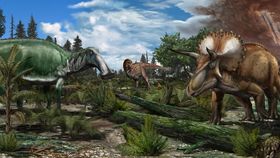


A rising chorus of scientists has recently challenged the popular view an asteroid impact wiped out the dinosaurs (birds excepted). However, the dominant theory, unlike said dinosaurs, refuses to lie down and die, and a new paper challenges an essential feature of the anti-asteroid brigade, arguing dinosaurs were doing fine just before the impact.
One of the central claims of those who dispute the asteroid-impact theory is that many animals, dinosaurs included, were in decline for millions of years pre-impact. Therefore, they argue, something else must have been responsible for this decline, with the volcanic eruptions that produced the Deccan Traps the most likely explanation. According to one interpretation, the asteroid was the final blow to an already teetering ecosystem. Another view questions whether the asteroid did much harm at all.
However, Imperial College London PhD student Alfio Alessandro Chiarenza argues the preceding dinosaur decline was an illusion. "Dinosaurs as a whole were adaptable animals, capable of coping with the environmental changes and climatic fluctuations that happened during the last few million years of the Late Cretaceous,” Chiarenza said in a statement. “Climate change over prolonged time scales did not cause a long-term decline of dinosaurs through the last stages of this period."
In Nature Communications Chiarenza points out our capacity to find fossils depends as much on geological conditions as species distribution. In the late Cretaceous, North America was split by an inland sea. We have far more fossils from the western side than the east, although there is no reason to think dinosaurs were more numerous there. Instead, vast quantities of sediment produced by the rising Rocky Mountains swept into rivers and lakes and helped preserve the bones of dinosaurs that died there. Appalachian deposits were probably always rarer, and those that did form were more likely to erode beyond the point of usefulness.
Chiarenza and co-authors created maps of the ecological conditions across North America 83 to 66 million years ago and concluded the territory suitable for major groups of dinosaurs actually expanded as the era went on, because the inland sea shrank. However, around 75 million years ago, what had once been a belt of fossil-preserving locations that stretched from Mexico to central Canada started to contract to smaller areas between 40 and 50 degrees north.

Allowing for this, the authors argue, there was no decline in North American dinosaurs before the asteroid, just a decrease in their preservation.
North America, of course, is not the world, so the work will need to be replicated elsewhere to confirm Chiarenza's conclusions. However, so much of what we know about dinosaurs comes from the western United States and Canada, that re-evaluations there are globally significant.