Nature
 PUBLISHED
 1
1


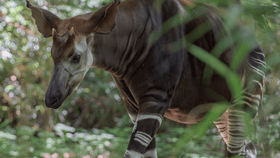


Walking around with your googlies on show can be problematic when you inhabit an environment ripe with pointy branches poised to poke your eye out. To overcome this occupational hazard, okapis have evolved an impressive way to avoid eye injury by sucking their vision balls back into their heads. The rather disgusting to watch – but undeniably effective – technique leaves them free to stroll through dense vegetation without the need for protective goggles to keep their eyes safe.
This eye sucking action was captured on camera by Oklahoma City Zoo in a video posted to their TikTok channel. It shows one of their resident okapis proudly pushing its peepers back into its skull allowing its nictitating membrane to sweep across its eyeball. Known as the “third eyelid”, nictitating membranes are present in several species including tree frogs, and they help to keep eyes moist and healthy.
Okapis, which look a little like a deer had a baby with a zebra, are remarkable creatures equipped with several adaptations that make them a perfect fit for life in the rainforests of the Democratic Republic of Congo. The dark coat on their upper body helps them to blend into their surroundings as they match the low light of the dense rainforest. Their zebra-striped legs also help to break up their silhouette in the undergrowth and are thought to help calves stick with their mothers while on the move.
Okapis also have famously long tongues measuring up to 30 centimeters (12 inches) which enable them to clean almost any part of their body, including their eyes. The handy appendage also gives them extra reach when foraging, and its dark color means it’s protected from getting burnt when wagging around in full view of the sun.
There’s a lot of eyeball retraction going on in the animal kingdom, but some species are better at it than others. The eye of the guitarfish can move a distance of 37.3 millimeters (1.5 inches) when retracting, and even our own eyes (as well as that of guinea pigs and rabbits) can retract at most 1.5 millimeters (0.06 inches) during a blink.
Something to ponder when you try to sleep tonight!