Nature
 PUBLISHED
 2
2


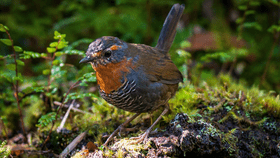


Nicholas Cage fans may have already embarked on one man’s journey in search of his truffle hunting pig when watching the movie Pig. If you enjoyed the film, the good news is there’s potential for a sequel only this time titled Birds, as it’s been discovered that two ground-dwelling bird species in Patagonia are proficient truffle hunters. Their fungus foraging skills make them the first non-mammalian species known to search for truffles, a feat published in the journal Current Biology.
The charming observation was something of a happy accident as researchers on the new study stumbled upon the birds’ unusual behavior while searching for truffles themselves in Chile. The two that appeared to show particular interest in the researchers were the chucao tapaculos (Scelorchilus rubecula) and black-throated huet-huets (Pteroptochos tarnii).
“When you search for truffles you carefully move the leaf litter to see the soil underneath and this slightly disturbs the leaf litter and soil,” explained study author and Assistant Professor at the University of Florida Matthew E Smith to IFLScience.
“In one remote forest in southern Chile (where the birds are not very used to seeing people and are unafraid), the birds actually followed us through the forest, and they visited the sites where we disturbed the soil and leaf litter. This was very surprising! It suggested that they were curious about what we might be searching for on the forest floor.”
You may be familiar with truffles in the form of rich oils or grated onto pasta, but there are a wide range of truffles out in nature, not all of them so fancy, characterized by the fact they grow underground. Their subterranean lifestyle means they’re reliant on animals consuming them and spreading their spores such as pigs, boar, and, evidently, birds. The ecological role these animals play is a crucial one, as the roots of many tree species benefit from a symbiotic relationship in which both parties share nutrients, helping to keep the forest happy and healthy.
The researchers had reason to suspect the birds were interested in their truffle search, but were the birds actually eating the spoils?
“Several other observations were also quite intriguing,” explained Smith. “These included finding truffles and other fungi with peck marks in them where birds had clearly been feeding, and the observation that some of the truffles in the Patagonian forests look almost identical to fruits that co-occur in the same forests. This is not something that I have seen anywhere else in the world, even after collecting truffles in at least six other countries on three continents!”

Sure enough, DNA analyses of the droppings of chucao tapaculos and black-throated huet-huets tested positive for truffles in 42 percent and 38 percent of samples for each species, respectively. Zooming in on the poop with the help of fluorescent microscopy also enabled the researchers to confirm that the droppings contained viable spores, proving that these little birds were indeed having a big impact on the secret sex life of truffles.
The team hope to return to the birds and the as-of-yet unnamed (scientifically speaking) truffle species they discovered during their hunting, to glean a better understanding of the behavior and investigate if the fungus in these regions has evolved any traits to be particularly appealing to birds.