Nature
 PUBLISHED


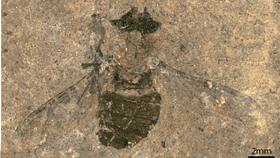


If you were found 47 million years after your death, what do you reckon scientists would be looking at when they examined your stomach contents? A last meal of Pizza Pockets might not survive the preservation process quite as robustly as the stomach contents discovered inside a fly who enjoyed its last meal way back in the Eocene. Published in the journal Current Biology, a new study was able to peek into the stomach of a fly that feasted on pollen approximately 47 million years ago, providing insights into the fly’s feeding behavior and its ecological role as a pollinator when it lived.
Using photogrammetry, a team of scientists was able to identify a mass of pollen inside the stomach of a fly locked inside an ancient fossil found in the UNESCO World Heritage Site “Messel Pit.” The species – which is new to science – sits within the Hirmoneura genus and has a body length of eleven millimeters (less than half an inch). Despite its advanced age, the fly’s stomach contents had survived the preservation process and revealed that when it popped its clogs it lay to rest with a belly full of pollen. This is the first evidence for this family of flies that they fed on pollen in the past.
Bees and butterflies often top the ecological heroes leaderboard as popular pollinators, but the role of other insects including flies (and ants!) is often overlooked. This new research shows that dipterans (the large fly family) have been doing their bit for pollen distribution for almost 50 million years (meanwhile, autonomous bubble-blowing drones could be the pollinators of the future).

“Such fossil food remnants are extremely rare on a global scale. They allow inferences as to the animals’ lifestyle and feeding behavior as well as the environmental conditions under which the animals lived at the time,” said Dr Sonja Wedmann of the Senckenberg Research Institute and Natural History Museum in Frankfurt in a statement. “The flies undoubtedly avoided long-distance flights between their food plants to save energy. We therefore assume that the plants associated with the pollen could be found within a relatively small area.”
The ratio of pollen supports the team’s hypothesis that the fly was feeding on plants that grew along the edges of the Messel lake and its surrounding forest. The fossil therefore shows, Wedmann concluded, that as far back as the Eocene flies have had a role to play in the distribution of pollen. “We assume that the flies played an important role in transporting the pollen, and thus in the propagation of several plant families. It is possible that flies were – and still are – more important than bees for the pollination of tropical plants.”