Nature
 PUBLISHED
 1
1




T. rex was so big, and so heavy, the ground literally shook as it walked. It’s not surprising that one of the scariest moments in film in the last 25 years is watching a glass of water vibrate to the sound of ominous approaching thuds. Only, according to a new study, T. rex was actually pretty stealthy, and could have snuck up on you without you even knowing.
That's according to Ernesto Blanco of the University of the Republic, Uruguay, and colleagues in a new study published in the Journal of Theoretical Biology. Blanco and team suggest that the seismic waves that travel through the ground when T.rex put each huge heavy foot down actually helped camouflage the beast so its prey couldn’t tell where it was.
Like elephants do today, big dinosaurs like Tyrannosaurus rex likely communicated with each other using seismic waves. Heavy footsteps and low rumbles produce low-frequency sounds that can travel through the ground. The researchers think that due to the size and shape of T. rex’s feet, the seismic waves produced with each stomp remained constant in their intensity even as they approached prey, which made it impossible to distinguish if the hunter was getting closer or moving further away.
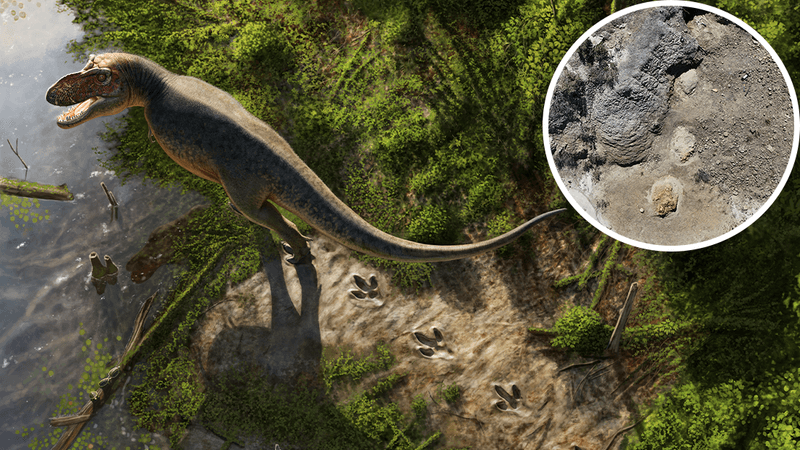
To work this out, Blanco and team analyzed 64 fossilized footprints of several large dinosaurs, including herbivores, omnivores, and carnivorous theropods (meaning “beast-footed”), bi-pedal dinosaurs like Tyrannosaurs. They found that the theropods had a more elongated foot shape than the others, twice as long as they were wide, compared to the herbivores and omnivores, whose feet were more regular.
They then simulated the seismic wave pattern created by each dinosaur’s foot shape when it hit the ground, and found a very curious thing happened with the theropods’ footfall. The seismic waves were weakest in the forward direction, and actually remained constant when within 25 meters (82 feet) of their target, meaning they could essentially sneak up on prey as their seismic waves disguised their approach – what the researchers have called “seismic wave camouflage.”
“So far, there is no evidence of a modern animal using this camouflage,” Blanco told New Scientist. “But it is a new concept. So perhaps it’s because nobody was looking for it before.”
There has long been debate about whether T.rex was a formidable hunter who tracked down prey or a scavenger who helped itself to other animals’ kills. We know that humans could probably outrun T. rex too, and since we aren’t particularly speedy compared to other creatures, it poses a question about how the dinosaur caught its prey. Perhaps this is the answer.