Nature
 PUBLISHED
 3
3

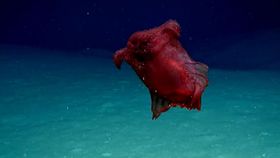


Meet the Enypniastes eximia, a particularly ludicrous-looking deep-sea swimming cucumber perhaps better known by its nickname the “headless chicken monster” (for fairly obvious reasons).
The bubblegum-pink critter is usually spotted lurking in the Gulf of Mexico but according to the Australian Antarctic Division, who oversaw the expedition, this is the very first time it has been filmed in the Southern Ocean close to East Antarctica.
Sea cucumbers like the Enypniastes eximia are found in every stretch of ocean, from seabeds just a few feet below sea level to depths miles below the surface. They are close relatives to starfish and sea urchins and spend most of their time wandering along the seafloor, searching for small food items, including plankton, algae, aquatic invertebrates, and waste particles.
This particular species of cucumber feeds episodically. When Enypniastes eximia is not hunting down prey, it spends its time leisurely bobbing along in the water columns just above the seafloor.
The Australian Antarctic Division (which is a part of Australia’s Department of the Environment and Energy) discovered the specimen using new underwater camera technology designed for long-line fishing.
"The housing that protects the camera and electronics is designed to attach to toothfish longlines in the Southern Ocean, so it needs to be extremely durable," Dr Dirk Welsford, Australian Antarctic Division Program Leader, said in a statement.
"We needed something that could be thrown from the side of a boat, and would continue operating reliably under extreme pressure in the pitch black for long periods of time."
The data collected during the exhibition will be presented during the 10-day annual meeting held by an international organization called the Commission for the Conservation of Antarctic Marine Living Resources (CCAMLR), starting today. Here, Australia will be looking to gain support for a new East Antarctic Marine Protected Area intended to extend environmental protections to conserve and protect the locality's unique wildlife.
"Some of the footage we are getting back from the cameras is breathtaking, including species we have never seen in this part of the world,” Welsford added.
"Most importantly, the cameras are providing important information about areas of sea floor that can withstand this type of fishing, and sensitive areas that should be avoided."
Australian Antarctic Division/Department of the Environment and Energy