Nature
 PUBLISHED


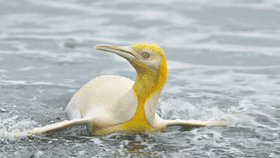


According to writer and self-proclaimed armchair naturalist Melissa Chen, the Mandarin for penguin roughly translates to “business goose,” and it’s easy to see why looking at these flightless birds and their monochrome tuxedo-like feather coloration. It seems, then, that one penguin on the remote island of South Georgia missed the black-tie memo, captured on camera by a wildlife photographer sporting bright yellow feathers instead of black.
The photos, taken in December 2019, were recently released and show the vibrant bird waddling through a crowd of seals and penguins, its feathers contrasting against the darker palette of its island pals. They were shot by Belgium-based wildlife photographer Yves Adams who led other photographers on a two-month expedition of the South Atlantic. While preparing his kit on the beach, Adams caught sight of the vibrant individual who stood out among a flock of penguins swimming ashore.
"I'd never seen or heard of a yellow penguin before. There were 120,000 birds on that beach, and this was the only yellow one there," Adams told Kennedy News & Media in a release emailed to IFLScience. "We all went crazy when we realized. We dropped all the safety equipment and grabbed our cameras."
There are a number of physiological quirks that can lead to unusual coloration in wild animals, such as leucism demonstrated by pale animals without pigment, or melanism where animals are entirely black (both of which have been seen in penguins). Adams suspected the yellow penguin in South Georgia might be the result of the former of these two conditions, lacking the melanin needed to make dark feathers. That the bird is a king penguin (Aptenodytes patagonicus) is significant as this species naturally has a burst of yellow feathers around their necks, so it stands to reason that these might dominate in an animal with little pigment.

Leucism stands apart from albinism, which is when an animal lacks any pigment at all and comes out bright white, often with blue or pink eyes. Whether or not this penguin was the result of leucism or albinism is still a source of debate as, to biochemically ascertain which it is, scientists require feather samples from the animal, which on an island so big might not be that easy to track down. Move aside, Where’s Waldo? Get ready for Peek at the Penguin.

Unfortunately for animals as snazzily dressed as this penguin, morphological abnormalities such as unnaturally bright plumage rarely benefit wild animals and can actually be a hindrance in affecting their reproductive success and making it easier for predators to spot them. Research into sightings of unusual spots and stripes in zebras found that they were often associated with inbreeding, the effect of which is a shrinking genetic pool and a rocky future for the survival of wild populations.
[H/T: LiveScience]