


 Nature
 PUBLISHED


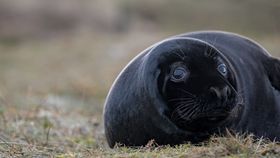


In what’s thought to be something of a baby boom for Blakeney Point’s seal colony, England's largest gray seal colony, rangers have spotted several melanistic pups among the National Trust Reserve’s new arrivals this January. Situated in north Norfolk, Blakeney Point has seen considerable growth in its pupping seasons’ yield in the last two decades, jumping from just 25 pups in 2001 to over 3,000 in 2019.
Most of these seal pups sport the typical dusty-white fuzzy coat that once helped them camouflage in an icy environment but has failed to keep up to date with the changing winter landscape in a warming world. Now, as they lay on the sand and pebbles in a perpetual sploot, they don’t blend in so well.
It's thought approximately one in 400 gray seal pups are melanistic. Melanism is a term used to describe living things whose body tissues are darkened as the result of excess melanin and it results in some beautiful, jet-black variations of a host of animals. It’s been seen in amphibians, reptiles, birds, and mammals, including our gray seal pups.
Rangers at Blakeney Point have seen 10 such melanistic seals this pupping season, which (in keeping with the 1/400 statistic) saw a record-breaking 4,000 new arrivals to the reserve. The seals arrive in October-November for breeding and leave in January once the seals have given birth and weaned their young.

The rangers used to monitor the pupping season by walking among the animals, but given the enormous baby boom this year they’ve had to do a rethink and come up with a safer strategy. Now, teams monitor the activity of pups in one specific area and use that information as an indicator of the activity happening across the entire colony.

The opposite effect to melanism is called leucism and it causes animals to have an unusually pale appearance compared to their friends due to a lack of pigment. Two near-glowing examples of this were spotted on the shores of South Georgia in the southern Atlantic Ocean where a particularly pale penguin and seal were spotted chilling on the beach. Leucism differs from albinism, a condition that removes all pigment leaving only white (and sometimes pink or red eyes), as it can produce a myriad of pale tones.

The (not so) gray seals have now left the point, a National Trust representative told IFLScience. The pups stay on the shore for several weeks with their mothers, who can lose around 65 kilograms (143 pounds) in the process of fattening up their precious progeny. Being a pup is thirsty work and they drink around 2.5 liters of their mother’s milk every day, ballooning in the space of a fortnight to a weight of around 30 kilograms (66 pounds). After the mothers return to the ocean, the pups work on their coat and confidence until finally plucking up the courage to follow suit a couple of weeks later.


