Nature
 PUBLISHED




The last known confirmed Tasmanian tiger died in 1936 at Hobart zoo, Australia. However, there’s been recurring reported sightings in the wild of this endangered beast ever since.
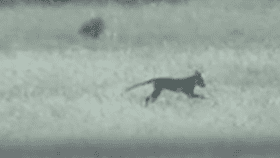
A new video (below) has been released appearing to show the Tasmanian tiger (Thylacinus cynocephalus), also known as a thylacine, roaming around South West Victoria. The grainy footage was said to be filmed at dusk, around 200 meters (660 feet) away from the animal. It follows on from another video (see bottom of page) released earlier this month claiming to show a Tasmanian tiger in a suburban area, rooting around trash cans in a front garden.
Dr Cath Temper, a mammals expert from the South Australian Museum, told the BBC that the latest footage "could really be anything".
She added: “There's never been a thylacine specimen from the mainland. But you never know, it would be arrogant if I said there was no chance."
Nevertheless, the group behind the video remain adamant that small pockets of Tasmanian tiger populations have survived in mainland Australia. Thylacine Awareness Group of Australia argue since this carnivorous marsupial was an apex predator and able to dig burrows, it’s likely it could thrive yet remain untraced in the vast Australian outback.
"Science doesn't want to touch it so it comes down to crazy people spending their own time and money looking for them – such as myself," the group’s founder Neil Waters told the Huffington Post.
"We need solid DNA evidence like hair or scat or sadly a roadkill carcass until they'll even think about it."
Aside from the grainy video footage and hazy eyewitness anecdotes, there’s little-to-no hard evidence around. In 2005, Australian magazine Bulletin and a Tasmanian tour operator put up a reward of AUS $3 million (US $ 2.2 million) for the live capture of a thylacine. The offer fell flat and no evidence at all was brought forward.
For the meantime, it seems like stories of the Tasmanian tiger will have to remain in the realm of rumor and cryptozoology, alongside the Loch Ness Monster, chupacabra, or Bigfoot.