Nature
 PUBLISHED
 1
1


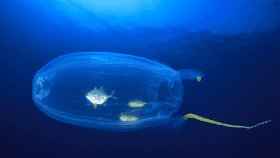


Salps are arguably one of the strangest organisms drifting around our oceans. They aren't jellyfish, despite looking a bit like them (a fish inside a jellyfish is whole other issue) and are actually more closely related to humans than jellyfish. As tunicates, they feed on plankton and spend their lives sucking seawater into an oral siphon, pushing it through a sieve-like structure (to scoop up the yum) before expelling it out the other end, known as the atrial siphon.
Certain images on the internet (the above included) might lead you to believe they ate fish, but these juvenile animals most likely actually swum inside the gelatinous blob on purpose. It might seem like a death wish, but inside a salp is actually quite a safe place to hang out if you’re just a wee fish (some of whom ride jellyfish).
Similar scenes were captured on camera by pelagic biologists and underwater photographers Sarah Matye and Jeff Milisen in 2016, who also came across a fish inside a salp. "This fish, a Holocentrid, is not being eaten by this salp, it is living inside the salp and hiding,” they said to IFLScience. “These larval fish hide wherever they can out in the empty pelagic ocean, and a salp makes a great home, especially when blinded by strobes!"
The defense strategy is not alone in using the body of a living thing as a hideout. Pearlfish are also fans of haunting the bowels of other sea creatures - quite literally - as they seek safety in the buttholes of sea cucumbers (who poop five Eiffel Towers per coral reef annually - didn’t you know?). You might sneer at such a concept, but - as the below footage demonstrates - it’s free real estate.
Unfortunately for salps, scaredy-cat fish aren’t the only critters trying to get all up in their grill, as a parasite so grisly it's thought to have inspired the film Alien is also found inside them. Parasites famously enjoy the insides of other living things, taking from them without giving back which is just so not mutualism. The parasite effectively carves out the center of the salp, using its siphon system to tour the ocean picking up snacks as they go.
Gentle floating balls of goo though they are, salps aren’t always so benign and recently caused quite the kerfuffle in the waters off the coast of South Korea. While not exactly anarchy (given it would be a stretch to accuse a salp of malice), they stuck it to nuclear power by jamming the cooling system for two reactors at one of the country’s nuclear power plants.