Nature
 PUBLISHED
 3
3


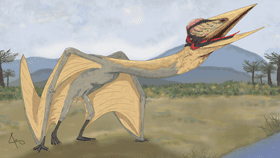


A giant predatory flying reptile has been discovered after fossil remains were unearthed in Argentina, becoming the largest pterosaur ever seen in South America and one of the biggest flying vertebrates in Earth’s history. The new species sits within the family of pterosaurs called azhdarchids, thought to have lived during the Late Cretaceous between 100 and 66 million years ago.
The “dragon of death” was given the Latin name Thanatosdrakon amaru, the first in reference to its deadly dragon-ness and the second derived from the South American native Quichua language for “flying serpent”. Amaru was a mythical deity of the Inca culture known as the “dragon of the Andes”.
Its enormous wingspan is estimated to have been between 7 and 9 meters (23 to 30 feet), as described in a new paper published in the journal Cretaceous Research led by Dr Leonardo D. Ortiz David, Coordinator General at the Laboratory and Museum of Dinosaurs at the National University of Cuyo in Mendoza, Argentina.
The new species is currently known from two specimens: a juvenile and an adult. Their proximity to one another indicates that, like other pterosaurs, these dragons of death lived in groups.

Beyond being impressive, winged predators, the specimens also represent some informative nuggets from the fossil record. They include bones never before described in giant azhdarchids, some preserved in their three-dimensional form.
“What most excites the research team about the discovery is the number of lines of work that the fossil remains will allow us to perform,” Dr Ortiz David told IFLScience. “[T]he good preservation of elements in three dimensions (an unusual condition for these giant flying vertebrates) allows us to perform muscle reconstructions and work to understand the kinematics of these animals.”

The palaeoecological interpretation of their findings (a fun word for the study of prehistoric animals’ ecology) indicates that T. amaru occupied river habitats where bodies of water met large plains to create floodplains with sparse vegetation, Dr Ortiz David told IFLScience. It also had several adaptations for spending lots of time on the ground, like fellow azhdarchid Quetzalcoatlus, a giraffe-sized pterosaur that can be seen getting up to some egg-based shenanigans in the Freshwater episode of David Attenborough’s latest series, Prehistoric Planet.
Azhdarchids were known for their large skulls and long necks compared to their body size. "The various lineages of derived pterosaurs have very large skulls in relation to the body," Dr Ortiz David explained. "The azhdarchids take this to another extreme. Long necks allowed this group of pterosaurs to develop feeding processes on land without problems, since, although they were flying animals, most of the time they were on land.
The researchers behind the discovery hope to next use bone sections and micro CT scans to find out more about T. amaru, including its growth patterns and the pneumaticity of its bones which could shed further light on the biology of pterosaurs.