Nature
 PUBLISHED


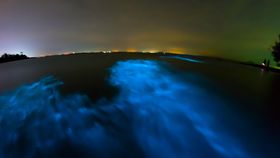


Glowing dinoflagellate plankton blooms create some of the most beautiful sights in nature. While feasting their eyes on some of the extraordinary spectacles biologists have been puzzled about why they do it. For the most studied of the many bioluminescent plankton species, the brief flashes of light deter grazers that would otherwise eat them.
Animals such as fireflies use the capacity to glow in the dark to attract mates, while others use it to attract their prey. Neither of these applies to the single-celled organisms that can turn night-time seas into shimmering fields of blue. Yet there has to be some evolutionary advantage. Producing so much light requires a lot of energy, and for organisms that can't run away, it is risky to alert grazers to their presence.
Andrew Prevett of the University of Gothenburg studied the interactions of Lingulodinium polyedra and the copepods that feed on them using high-speed, low-light-sensitive videos. He reports in Current Biology that when L. polyedra senses the presence of a copepod (a sort of small crustacean) it gives off a flash of blue-green light lasting around a tenth of a second. This causes the copepod to stop sweeping the dinoflagellate towards its mouth and allows the prey to escape while the copepod seeks non-bioluminescent prey.

L. polyedra grow at only a third of the rate of diatoms, another form of plankton that inhabit the same waters, presumably because developing and applying bioluminescent capacities gets in the way of other things. In most circumstances this leads to L. polyedra being displaced by species capable of faster growth. Off the west coast of Sweden, however, the exception is copepod-rich waters. Presumably, the small crustaceans keep rival plankton numbers down, offering space for their sparkly cousins.
"There are three popular theories as to how bioluminescence protects dinoflagellates," Prevett said in a statement. If the dinoflagellate produces toxins light can be a way of alerting grazers this is something they don't want to eat. The sudden flash may also startle the grazer and disorientate it enough to allow the dinoflagellate to escape.
“The third theory suggests that the flash acts as a form of burglar alarm, attracting the attention of a larger visual predator, like a fish, which could track and consume the copepod,” Prevett added. “There is evidence to support each of these theories and bioluminescence protection could be combinations of some or all of the above."
The benefits may vary by species and the grazers that feed on them. Not all L. polyedra are bioluminescent and Prevett's copepods were seen to feed happily on non-glowing L. polyedra, which fits poorly with the first explanation.