Nature
 PUBLISHED
 8
8


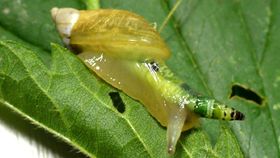


Over the last few days, a video of a snail infested by a mind-controlling parasite has gone viral. The rhythmic movement and color of the parasite inside the transparent creature had many liken it to a raver dancing to beats with glow sticks on their limbs.
The video was shot in Changhua County, Taiwan, earlier this month by Lin Ruian, who was hiking through the forest. The footage then spread on the internet, where it lost its original accreditation and made its way to Reddit. There, it was picked up by biologist Mike Inouye, who posted it on Twitter and it quickly went viral. It has now been seen 6 million times.
The pulsating parasite in question appears to be from the genus Leucochloridium, a clever flatworm that uses gastropods like snails as an intermediate host. What we see here is the larval stage of the worm. Once it infects the snail, the parasite takes over the invertebrate, getting in the eyestalks and head.
Infected snails have been witnessed to spend more time in higher and/or sunlit places, making them more likely to succumb to predation from birds. To make it even more likely, the larvae look like maggots or caterpillars, with their rhythmic movements bound to attract the attention of birds. The pulsation seems to be related to the amount of light they receive, according to some research conducted on the green-banded broodsac (Leucochloridium paradoxum) a few years ago in Poland.
Once a bird has its fill of infected snails, this parasite enters adulthood. Inside the bird’s gastrointestinal tract, the Leucochloridium larvae mature and release eggs. These eggs are then excreted by the birds. And guess who ends up eating the eggs? You’re right, the snails. And the cycle restarts anew.
Infected snails have been dubbed zombie snails, as they carelessly put themselves in harms way on the behest of the flatworm so that the parasite can exhibit its aggressive mimicry behavior. Usually, aggressive mimicry has the predator pretend to be someone else’s prey, fooling victims into becoming their meals. But not for the Leucochloridium, they want to be eaten.