


 Space and Physics
 PUBLISHED


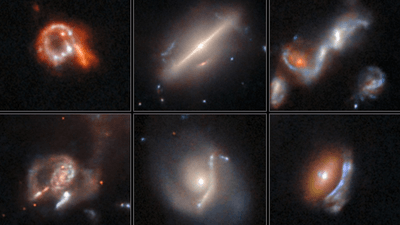


Astronomers have used artificial intelligence (AI) to find hundreds of "anomalies" in data from the Hubble Telescope. More than 1,300 unusual objects were found in the search, with over 800 never before being documented in the scientific literature, and 43 objects that defy classification into any known objects.
Astronomers around the world have been spoiled for data in recent years. The Hubble Space Telescope itself has made over 1.7 million observations in its three decades of operations. But with a large amount of data to search through, a lot of interesting and unusual objects can be missed.
While astronomers are good at spotting unusual data, and galaxies within the data, researchers David O’Ryan and Pablo Gómez of the European Space Agency (ESA) created an AI tool to assist with the search, capable of looking at millions of observations in a tiny fraction of the time it would take humans to do the same. Named AnomalyMatch, the software was trained to recognize patterns in data, and flag up any unusual-looking objects to human researchers.
"Rare objects, often termed astrophysical anomalies, are particularly informative for improving our understanding of galaxy evolution and cosmology," the team explains in their paper. "For example, strong lensing – a gravitational effect of chance alignment of galaxies – allows precise testing of the gravitational potential of the foreground galaxy, as well as the in depth study of the background galaxy from magnification effects."
Looking at the data, AnomalyMatch flagged up plenty of potential anomalies for further inspection. Manual review by astronomers confirmed over 1,300 of these objects as true anomalies. The team was first motivated by finding edge-on protoplanetary disks, rare objects usually only spotted in the background of observations focused on another target, before expanding the search to objects like mergers, lenses, and jellyfish galaxies.
Around 50 percent of the anomalies found were galaxies undergoing mergers with other galaxies. The next most common anomalies are thought to be gravitational lenses – where objects with large mass have bent the light we see from more distant sources – though these would need further observations to be confirmed.
The team also found several edge-on protoplanetary disks. As well as this, the AI flagged up lensed quasars, notable as it had not been specifically trained on this type of object.
But there were also a few objects that were a little more difficult to classify.
"Finally, we find 43 objects with morphologies defying classification. Some of these objects may not be galaxies but rather other objects that we have limited expertise in classifying," the team explains. "We release these to the community for further discussion, or use, but do not attempt to make morphology classifications here. None of these objects have definitions in the literature."
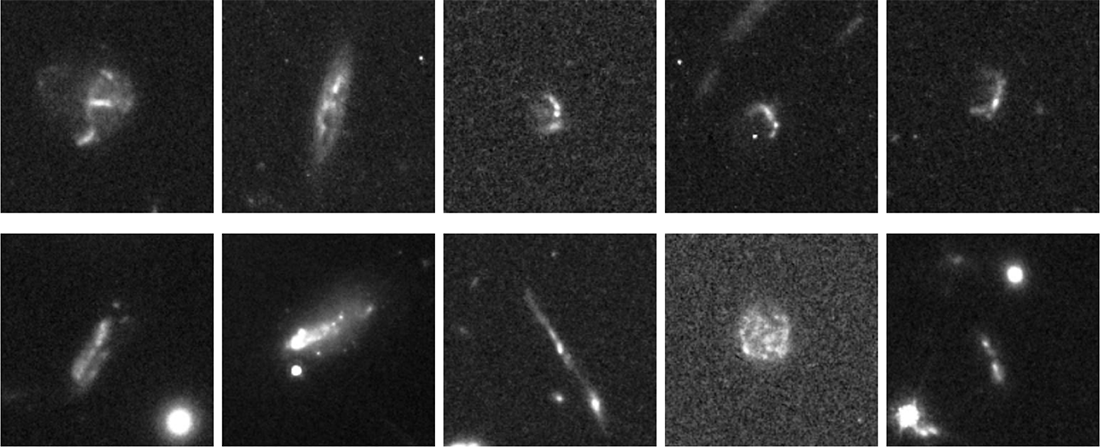
While these objects still defy explanation, the team suggests that many of them could be "jellyfish galaxies" as they appear to show signs of ram pressure stripping.
"Ram pressure stripping occurs when galaxies encounter the diffuse gas that pervades galaxy clusters," NASA explains. "As galaxies plow through this tenuous gas, it acts like a headwind, stripping gas and dust from the galaxy and creating the trailing streamers."
Further observations and analysis of these objects are needed in order to figure out exactly what they are. While interesting, the main focus of the research was on AnomalyMatch itself. The team believes that the AI could be particularly useful for looking through the data from large surveys, such as Euclid or the Vera C. Rubin Observatory, which will produce large volumes of data every night and would be cumbersome to look through manually.
"This is a powerful demonstration of how AI can enhance the scientific return of archival datasets," said Gómez in a statement. "The discovery of so many previously undocumented anomalies in Hubble data underscores the tool’s potential for future surveys."
The study is published in Astronomy & Astrophysics.

 1
1