Space and Physics
 PUBLISHED
 1
1



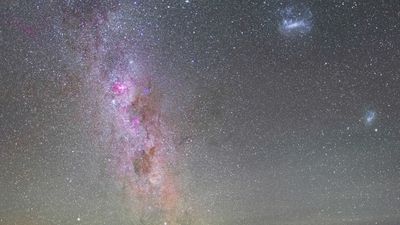


Our galaxy, the Milky Way, is surrounded by smaller galaxies. The precise number is difficult to estimate – the galaxies are small and dim, and they end up blending with the background objects and foreground stars. Theory suggests that there should be a lot more dwarf galaxies around the Milky Way than we see. But now, astronomers think we might have more small galaxies close to the Milky Way than should be possible.
These two apparently opposite problems seem to be happening at the same time, and they are linked with each other. They all depend on the Standard Model of Cosmology, which expects the existence of dark matter and dark energy as the major components of the Universe. According to simulations from the model, there should be over 200 dwarf galaxies around the Milky Way.
We are nowhere near finding that number. There are less than 70 known dwarf galaxies within 1.4 million light-years of the Milky Way, including candidates. All the others might be just too faint, or in a difficult position for us to easily spot them.
The model also gives an estimate for how many of these different galaxies should exist within a certain distance. Within 650,000 light-years, there should be 3.9 galaxies. This is what the team found in this yet-to-be-peer-reviewed paper. But in the same paper, the team announced two new candidate satellite galaxies and confirmed the existence of three more candidates. Their names are Virgo I, Cetus III, Bootes IV, Sextans II, and Virgo III.
But even if we want to be extremely skeptical of these five potential galaxies, there are four other galaxies whose existence has been confirmed: Sextans, Leo IV, Leo V, and Pegasus III. There are also the Large and Small Magellanic Clouds, dwarf galaxies visible to the naked eye in the Southern Hemisphere. A recent paper suggests that they are not two galaxies but three. So instead of less than four galaxies within that distance, we might have 11 or 12 objects.
So, is it too many galaxies or too few? The researchers are not picking a camp beyond saying that more observations are needed to truly understand these objects and their distances. Even the models are based on assumptions that might be too restrictive. Future surveys might actually bring forth a better understanding of these and yet-to-be-discovered galaxies.
The paper documenting this discovery is available on the preprint repository ArXiv.
[h/t: Universe Today]