Nature



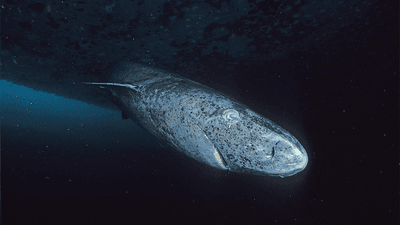


Swimming around the cold waters of the North Atlantic and Arctic Oceans is a shark species that can live for so long that some alive today likely lived through the American Revolution.
If larger estimates are to be believed, a few may even have lived through the Protestant Reformation, not that either event would affect Somniosus microcephalus too much, living as they do at depths of around 1,200 meters (3,937 feet) underwater and not really taking an interest in human affairs.
We now know the elusive Greenland shark to be the longest-living vertebrate on Earth, but finding that out wasn't easy and involved a little help from our old friends, nuclear weapons.
In 2016, we knew that these creatures were able to get pretty old. Over 50 years prior, Danish fishery biologist Paul Marinus Hansen established that they grow just a few centimeters over several years despite regularly reaching lengths of over 5 meters (16 feet), making them the largest fish native to Arctic waters and clearly able to get "quite old."
One technique for estimating the age of fish is to look at calcified structures, including inner ear bones, and their scales.
"Due to seasonal changes in temperature or food availability, major life history events are recorded as markings on their scales or bones," Fishbio explains. "Much like the rings on a tree, fisheries researchers can use these patterns to estimate both the age and growth of a fish."
While that is good to know, this technique is useless in Greenland sharks due to a lack of calcified tissue. Instead, the 2016 team of international researchers used radiocarbon dating on the eye lens nuclei from 28 specimens collected in Greenland between 2010 and 2013.
Radiocarbon dating is generally used in more archaeological settings, such as figuring out how old a piece of wooden furniture is, rather than a shark. But the radiocarbon and stable isotope levels in the eye lenses of these sharks, which are dictated by the diet of the sharks' mothers, helped the team to estimate their age.
"In vertebrates, the eye lens nucleus is composed of metabolically inert crystalline proteins, which in the center (i.e., the embryonic nucleus) is formed during prenatal development," the team explains in their paper. "This tissue retains proteins synthetized at approximately age 0: a unique feature of the eye lens that has been exploited for other difficult-to-age vertebrates."
So, where are nuclear bombs going to enter the equation?
"Since the mid-1950s, bomb–produced radiocarbon from atmospheric tests of thermonuclear weapons has been assimilated in the marine environment, creating a distinct 'bomb pulse' in carbon-based chronologies," the team explains. "The period of rapid radiocarbon increase is a well-established time stamp for age validation of marine animals."
In short, at around that time, enormous amounts of the radioactive isotopes C-12 and C-14 were released into the environment and found their way into the tissues of marine creatures minding their own business and not participating in any war (THAT WE KNOW OF).
Looking at the smaller Greenland sharks sampled, which are presumed to be at the younger end of the scale due to their size, the team found far higher levels of radiocarbon than in the older sharks. While they couldn't provide an age estimate of these younger sharks, the presence of high levels of radiation indicated that they were born after this "bomb pulse."
Although only the youngest sharks contained the nuclear signature, that signal provided a crucial calibration point for the team. By identifying the approximate age of one relatively young shark and looking at its size, the researchers could anchor a growth model that allowed them to estimate the ages of much larger sharks born centuries before nuclear testing.
Studying the older and larger sharks, the team estimated the oldest could reach 392 years of age, with an average lifespan of the sharks estimated to be about 272 years. Given that female Greenland sharks reach sexual maturity at around 400 centimeters (13 feet) in length, the team estimates that this happens at around 156 years of age.
"Our results demonstrate that the Greenland shark is among the longest-lived vertebrate species, surpassing even the bowhead whale (Balaena mysticetus, estimated longevity of 211 years)," the team concludes, adding, "our estimates strongly suggest a precautionary approach to the conservation of the Greenland shark, because they are common bycatch in arctic and subarctic groundfish fisheries and have been subjected to several recent commercial exploitation initiatives."
These sharks live a long time, and they're in no rush to get anywhere, either, with a top speed of around 2.9 kilometers an hour (1.8 miles an hour), making them one of the slowest sharks in the ocean.
They lie in wait for food, using a sucking action to feed on unlucky prey that passes near their mouths. Despite this, they have been found to feast on live seals. Scientists think they sneak up on these seals while they sleep in the water, which seals do to avoid polar bears.
Speaking of polar bears, while Greenland sharks mainly eat fish, they have occasionally been found to snack on the odd bear too. The sharks haven't been observed doing this – they are extremely elusive creatures – but polar bear parts have been found in their stomachs, as well as the jaw of a bear cub.
Experts suspect this bear was dead before the Greenland shark ate it, though. Even when you are centuries old and have picked up a few marine combat techniques in your time, it's best not to take on a polar bear.
The study is published in Science.



 1
1