Space and Physics
 PUBLISHED


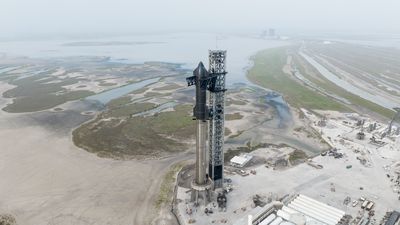


On Friday night, local Texas time, SpaceX’s Starship V3 took to the sky. The flight – the 12th for Starship but the first for this version – was mostly a success, demonstrating the latest iteration of the spacecraft and booster, deploying some payload, and doing some important tests in reentry.
There were also some hiccups: several engine failures, an explosion, and changes to the plan. SpaceX is seeing this as a success, having achieved most of the goals and, more importantly, having tested their new version of this vehicle on a real launch. It also seems to have given NASA some confidence in using Starship as the lander to take its astronauts to the Moon in 2028.
“One step closer to the Moon…one step closer to Mars,” NASA administrator Jared Isaacman congratulated SpaceX on X. So, what needs to happen next if Artemis IV is to meet its deadline?
What happened in this test?
On the good side of things, Ship 39 – as this particular Starship vehicle is known as – was able to get into its transatmospheric orbit. It deployed 20 dummy satellites in a setup described as a space PEZ dispenser, as well as two real ones that delivered some great footage of Ship 39 in space.
The vehicle performed a soft splashdown in the Indian Ocean, similar to previous launches, but on the way down, it tested certain reentry angles and configurations, which will be necessary when it lands safely for reuse.
There was a bit of engine trouble, though. During ascent, it lost one of its Raptor engines, which meant that getting into orbit was not exactly what SpaceX had planned.
"I wouldn't call it nominal orbital insertion, but we're in on a trajectory that we had analyzed and it's within bounds," SpaceX spokesperson Dan Huot stated during the live commentary.
Ship 39 did not attempt to relight its engine in space, a test that was expected to happen during the flight. It was worse for the booster. Following the hot-staging, the Superheavy rocket ‘Booster 19’ was only able to relight 20 of its 33 engines.
They were supposed to take that portion of the vehicle back to base to be captured by the mechanical chopsticks setup; instead, it ended in a fiery explosion over the Gulf of Mexico.
What’s new with Starship?
This is the Block 3 version of Starship. The vehicle is taller and more powerful. The new ship is almost 1.8 meters (6 feet) taller than the previous version and produces 14 percent more thrust than the Block 2 setup. Payload capacity was increased to 100 tons from the previous 35.
The booster is also more powerful and taller than its predecessor. The booster rocket is expected to produce 10 percent more thrust at ignition than Block 2. When they are in the final configuration, their combined height is 124 meters (408 feet). It is the tallest rocket ever built.
.png "A helpful schematic that shows which bits of a rocket are which, with the crew or cargo capsule at the pointy end and the boosters on the side .")
Starship’s needed giant leap
Starship is one of the two Human Landing Systems for the Artemis program. The other is Blue Origin’s Blue Moon. NASA chief Jared Isaacman recently announced a major shift in the program to bring humans back to the Moon. A lot is riding on it, and in fact, Isaacman went to see this launch in person.
"We're looking forward to seeing this thing fly, because hopefully at some point in the not-too-distant future we're gonna join up in an Earth orbit," Isaacman stated during the livestream.
Originally, the next mission, Artemis III, would have landed humans on our natural satellite using Starship. It was clear that the delays to Starship would not have made it possible. Now Artemis III will have the crew rendezvous with Starship and/or Blue Moon. This was supposed to happen mid-2027, but has now been postponed to at least late-2027.
What Starship needs to show to get humans to the Moon
A few things are needed for NASA to be satisfied that Starship is safe for humans to travel to and from the Moon. One test expected to happen this year is the in-orbit propellant transfer demonstration. Basically, Starship needs to be able to get refueled in orbit. Two Starships will be launched for this, a few weeks apart.
The demonstration is a cornerstone for future SpaceX strategy. The idea is to have Starship in orbit around the Moon, where the Artemis IV astronauts will meet it in the Orion capsule launched on NASA's SLS rocket in 2028. Then Starship will bring them down to the surface and then back up to meet the Orion spacecraft.
For that to work, Starship needs to be fueled up. It has been previously estimated that at least 15 launches of Starship tankers will be needed to fuel up the Human Landing System Starship. The exact details of this plan might have changed since 2024, due to changes to the vehicle capacity.
The other crucial demonstration is landing. So far, Starship has at most soft-landed on the ocean. The vehicle needs to demonstrate capabilities to soft land on the ground and launch back, first on Earth, and then on the Moon. The lower gravity makes it easier to take off, but there are disadvantages, too. The lunar surface is not exactly a launchpad.
How’s the timeline looking?
Last November, a leak of internal SpaceX documents, reported by Audrey Decker at Politico, revealed that Starship wouldn’t be ready to land on the Moon until at least September 2028, assuming everything goes well.
If this is correct, it might push Artemis IV and Artemis V from mid and late 2028 to 2029, at the very least. Blue Moon has not been tested in space either, so there’s speculation on how well the alternative is doing.
It is an overused line that space is hard. To explore space safely, you can’t rush it, as there are necessary tests to be performed. To match the current timeline, Starship needs to ace all the tests going forward. Any setback is a likely delay to returning humans to the surface of the Moon.