Space and Physics
 PUBLISHED


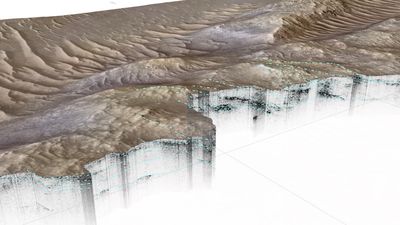


NASA's Perseverance has been exploring Jezero Crater for five years, traveling across the Western Delta, a river structure that has been seen from orbit and a crucial reason for sending the rover there. New analysis suggests that fluvial features are not just skin-deep in this area of Mars. They go down deep, providing new insights into what Mars used to be like.
Using the Radar Imager for Mars Subsurface Experiment (RIMFAX), researchers were able to study deep under the surface of the crater. During 78 traverses, Perseverance collected data from 35 meters (115 feet) deep underground. It revealed river and delta features that had been buried. This suggested that there was flowing water and possibly the right conditions for life in Jezero Crater for longer than previously thought.
“RIMFAX has revealed an earlier subsurface delta environment under the present-day delta, and this extends the period of potential habitability for Jezero back further in time,” lead author Dr Emily Cardarelli from the University of California, Los Angeles (UCLA) told IFLScience.
The Western Delta, visible in orbital observations, is believed to have formed around 3.7 billion years ago. The buried one is expected to have started its formation around 4.2 billion years ago, dramatically extending the time this area was wet.
The buried structures are found under a deposit known as the Margin unit, rich in magnesium carbonates. The team found that the buried structures suggested multiple erosional and depositional episodes, while showing that the area was active with flowing water for a very long time.
“As predicted from the orbital observations, RIMFAX confirms that the Margin unit is a distinct geologic unit from the upper fan that was deposited earlier and is distinct in composition as well as in physical area,” Dr Caldarelli told IFLScience.
“However, this work suggests that there is some continuity in formation between the Margin unit and the upper fan with a repeated process in Jezero Crater, but at distinct different times of formation and deposition.”
The work strengthens the case for a habitable environment. There has been evidence found by both Perseverance and Curiosity that is considered the best yet to suggest the possibility of life beyond Earth. Let’s stress that nobody is claiming the discovery of alien life, but these rock signatures have raised some eyebrows.
The work only focuses on 6 kilometers of Perseverance’s path on Mars. The rover has now completed 40 kilometers, leaving the delta and venturing forth.
“I'm excited for us to be exploring these new terrains outside the crater rim of Jezero,” Dr Cardarelli told IFLScience. “I'm also excited for us one day to return to this area, the Neretva Vallis region, that's the inlet channel where we detected compelling signs of past microbial life.”
RIMFAX is a Norwegian-built instrument, and its daily operations are shared between the University of Oslo and UCLA. Dr Cardarelli was keen to stress what a group effort this whole research was.
“I just want to communicate that [Perseverance] is really a close-knit science team filled with people from around the world,” Dr Cardarelli told IFLScience.
“It’s really wonderful to come together in this larger goal of exploring another planetary body that could potentially inform even what we know about our own planet, since rocks of this age are really not well preserved.”
The study is published in the journal Science Advances.