Space and Physics
 3
3


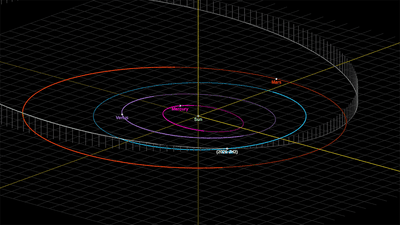


A newly-discovered asteroid, dubbed 2026 JH2, is about to have a very close encounter with Earth, coming so close that it should be visible to observers on our planet with some fairly modest equipment and a helpful live stream.
Astronomers around the world, as well as automated systems constantly scanning the skies, are always on the lookout for potentially-hazardous objects making their way through our Solar System. As well as looking for interesting objects in the sky, the goal is to check for any possible dangers the space rock may pose to our planet.
A few days ago, astronomers from several observatories, including the Mount Lemmon Survey and the Farpoint Observatory in Eskridge, observed a new object getting quite close to our neck of the woods. Preliminary calculations of its orbit showed that its path takes it not quite out to Jupiter, and very close to the orbit of Earth, making it an Apollo class near-Earth object (NEO).
The European Space Agency estimates that 2026 JH2 is around 15-35 meters (50-115 feet) wide, and it looks like we will get a really good look at it, with the asteroid currently predicted to make a very close approach to Earth on Monday, May 18, 2026, at about a quarter of the distance the Moon is from Earth.
So, are we in danger? Is it time to crack each other's heads open, and feast on the gooey bits inside? As usual, no. Whilst the asteroid is coming incredibly close in space terms, there is no suggestion that it will impact the Earth.
At around 5:23 pm EDT (9:23 pm UTC), the asteroid will make its closest approach, coming within 0.00064 AU of Earth at maximum and 0.00058 AU at minimum, with one AU being the average Earth-to-Sun distance.
As stated above, that is pretty darn close in space terms, but it looks a lot less worrying when you put it in terms of kilometers and miles. At its closest approach to the Earth, it will still be around 90,000 kilometers (56,000 miles) from slamming into our planet, or around 24 percent of the average distance between Earth and our Moon.
In short, it will miss our planet, and we should be able to get a good look at it whilst it does so. According to the Virtual Telescope Project, it will reach magnitude 11.5, making it visible with a modest amateur telescope. Should you not have access to clear skies and a telescope, the Virtual Telescope Project will begin livestreaming observations of the asteroid at 3:45 pm EDT (7:45 pm UTC).