Space and Physics
 PUBLISHED


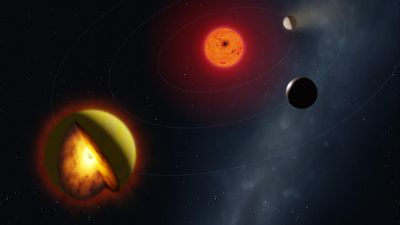


The planets of the Solar System are not representative of all the types of planets that exist elsewhere in the galaxy. There are worlds like hot Jupiters, gigantic and very hot, as well as ocean worlds and super-Earths with a rocky structure but a much thicker atmosphere than our own planet. Now, a new study suggests the existence of a new type of planet, thanks to fresh research into exoplanet L 98-59 d.
This world is part of a planetary system with four other planets, including a super-Venus and a possibly habitable super-Earth. L 98-59 d was also classified as a super-Earth or a sub-Neptune, a planet in between, based on its size. What was peculiar was its density, which was much lower than expected.
The planet, located 35 light-years from Earth, has a radius of 1.6 times that of Earth but a density of less than two-thirds of our planet. One possible explanation was that it was a gas dwarf, with a large atmosphere and a smaller rocky structure underneath. Another would have it as an ocean world, again, having a large atmosphere with a different level of water and ice under high pressure. Observations from JWST in the last few years, however, pointed somewhere else.
The space telescope revealed an incredible abundance of hydrogen sulfide in the planet’s atmosphere. Matching the observations to the computer simulations, the team behind the new study was able to create a full history of this world – and it does not match any known type of planet.
“What we did in our paper is say: ‘let's try and connect how this planet formed with the present day observations,’” lead author Dr Harrison Nicholls, from the University of Cambridge, told IFLScience. “We know it's about 5 billion years old. We have the sulfur detection, we know its density, its mass, and radius. How can we explain what we're seeing now?”
The answer is that L 98-59 d is a molten world like no other. It has a large and rich atmosphere, over a molten mantle with a deep magma ocean extending for thousands of kilometers. Astronomers and planetary scientists have found several molten worlds, but the reason why they are covered in a lava ocean is that they are intensely irradiated by their stars. This world is different. It is its thick atmosphere that keeps it molten.
“We can say this planet formed in a way which is different from the Solar System[‘s planets] and different from the other exoplanets: there are a couple of things which are unique here,” Dr Nicholls told IFLScience.
“Altogether, it speaks to this idea that maybe there are populations of planets in our galaxy, which we can't explain using existing models. Maybe, we will see more planets like this, these molten sulfur worlds or whatever we're going to end up calling them.”
Upcoming missions like PLATO (launching at the end of the year) and ARIEL (currently being tested) could help with that goal. PLATO will look at one million stars to find rocky worlds, while ARIEL will study the atmosphere of 1,000 exoplanets in greater detail than ever before. Molten sulfur worlds might end up being just one of the many cosmic oddities out there.
“I hope people realize that astronomy and planetary science are changing so much at the moment. It's a bit of a Wild West, almost, where we don't know what's about to happen next,” Dr Nicholls told IFLScience. “It's a super exciting time, and we're going to keep getting surprised!”
The study is published in Nature Astronomy.
An earlier version of this article incorrectly stated Dr Harrison Nicholls as from the University of Oxford. It has been corrected to the University of Cambridge.