Nature
 PUBLISHED


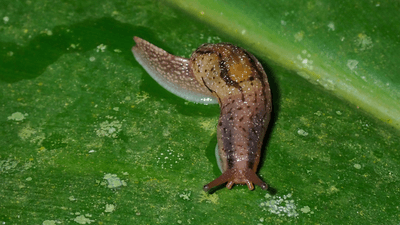


A new species of semi-slug has been discovered in the hot lowland forests of Ulu Temburong National Park, Brunei, with the aid of citizen scientists. In case this is the first time you’re hearing of a semi-slug, sometimes called “snugs” by mollusk researchers, these slimy babies carry the halfway-house between a slug and a snail.
Snugs have shells on their backs, but they’re too small for the mollusks to retreat inside. Instead, they act as a sort of tea cozy of protection while the worm-like bulk of their body stays exposed. Snugs make up the majority of slugs found on Borneo, an island shared by Brunei, Malaysia, and Indonesia.
It’s home to 10 semi-slug species from the Microparmarion genus, all of which enjoy basking in the cool mountainous forests. However, the peculiar snugs threw another curve ball when a new species was discovered sliming through the hot lowland forests of Ulu Temburong.
The snug was spotted during an expedition jointly led by Taxon Expeditions and Universiti Brunei Darussalam (UBD) who have been running biodiversity discovery trips for scientists, students, and laypersons for many years. The 2018 expedition to these forests included ethical pest control company owner Simon Berenyi, who spotted something under a leaf that others in front of him had ducked under.

It was slimy with a shell of sorts, but not one Berenyi recognized. The expedition team gathered to ponder the mollusk's identity and zoologists suspected it might be a new species, but they were going to need more than one if they were going to get it published.
Teams have returned to Ulu Temburong several times over the past few years, turning up more and more specimens that matched Berenyi’s peculiar snail-slug. Eventually enough observations had been made for UBD students Nurilya Ezzwan and Izzah Hamdani, and citizen scientist Harrison Wu from Virginia, USA, to put together a formal description for the new snug species.
“We describe Microparmarion sallehi [...] after field centre supervisor Md Salleh Abdullah Bat,” they wrote in a new paper. “We provide details on the external and internal reproductive morphology, the shell and the ecology of the type locality, as well as a diagnosis comparing it with related species.”
It becomes one of just two known species of semi-slug to be found in lowland forests rather than mountainous ones, sitting alongside its snug bud M. exquadratus. M. sallehi was named after Mr. Md Salleh Abdullah Bat, the team’s field center supervisor, who was due to retire a few weeks after their project was finished.
The new snug appears to be the most basal of the species so far described in the genus, possibly suggesting that speciation events have followed a shift towards habitats at a higher elevation. Further research is needed to form firm conclusions about these elusive mollusks, but with their sightings being so rare it could be some time before we get there.
Peepers at the ready, folks. We’re going snug seeking.
The study is published in the Biodiversity Data Journal.