


 Nature
 PUBLISHED


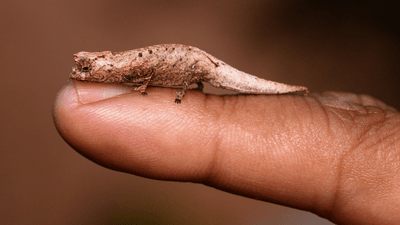


Rejoice! There’s a new tiny chameleon on the block. Hailing from Madagascar, it joins other miniature chameleons in the Brookesia genus, subgenus Evoluticauda. At little bigger than the end of your forefinger, it was a remarkable spot in what’s presently a highly threatened habitat in Madagascar.
The new-to-science species has been named Brookesia nofy after the forest it was found in, known as Ankanin’ny Nofy. Sitting at about sea level, it’s a littoral forest making this the first of the mini chameleons to be found in this kind of habitat. It’s also a popular spot for tourists, which contributed to its discovery.
Photos posted on social media alerted a team of scientists to the fact that a new-to-science species may be wandering in their midst. Remarkably, when they went out to search for it, they were successful in finding it. A task surely comparable to looking for a moving needle in a haystack.
They’re not easy to track down, but as Mark D Scherz told IFLScience following another mini-chameleon discovery, you get better at it. “It takes a lot of patience and an eye for it. With practice, one can get relatively good at it, but we often work with local guides who are particular experts in finding these tiny chameleons as well.”

The Brookesia genus is home to some truly remarkable leaf chameleons, so named for their coloration. Some are very ornamental, like B. perarmata, and others are very small, like B. micra. At around 33 millimeters long, B. nofy is not quite the world’s smallest. That title, for now, goes to B. nana, a name that becomes all the more fitting when you learn it’s got famously large genitals.
Nothing like that to shout about when it comes to the latest Brookesia recruit, but it does stand out for its choice of habitat.
This species in particular is the only mini-chameleon in Madagascar known to occur in littoral forest, one of the most threatened habitat types.
Miguel Vences
“While Brookesia nofy has no conspicuous or spectacular external features, it is one more example of the large diversity of miniaturized chameleons on Madagascar, most of which appear to be restricted to very tiny distribution ranges,” study author Miguel Vences told IFLScience. “This species in particular is the only mini-chameleon in Madagascar known to occur in littoral forest, one of the most threatened habitat types.”
“Furthermore, it is striking that the only apparent safe haven for the species is a privately-owned forest used for ecotourism, while the few remaining natural forest patches around it are under heavy pressure as we speak by slash and burn agriculture.”
A tricky spot to navigate as a tiny chameleon, then, and it’s the study authors’ hope that B. nofy’s discovery can emphasize the importance of conserving Madagascar’s last remaining fragments of littoral forest.
The study is published in ZooTaxa.




 1
1