Nature
 PUBLISHED
 2
2


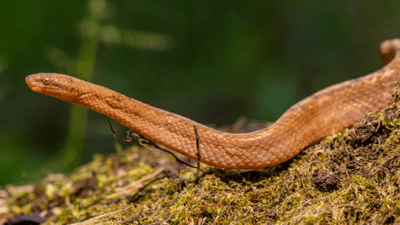


In the cloud forests of north-eastern Ecuador, a little snake has been slithering around harboring a fascinating secret. Tucked within its anatomy are the remnants of a pelvis, something snakes haven’t needed since they first lost their legs around 150 million years ago.
Vestigial organs and limbs are remnants of evolution that demonstrate how simply not needing something isn’t enough for an organism to evolve out of having it (have you ever had the displeasure of seeing someone feed horse chestnuts to their dog?). Evolutionary pressure is needed to delete a characteristic entirely, which is decided based on how that particular feature increases or decreases an animal’s fitness to its environment, and as such how likely it is to survive and thrive.
The degree to which an animal loses certain features can vary across species. There are actually several species of snake with these kinds of evolutionary hangovers, such as pythons, who not only have a vestigial pelvis but also have two spurs that were once legs.

Now, a new species of Tropidophiidae snake joins the vestigial pelvis gang, after being scientifically named for the first time by researchers working in the Ecuadorian Amazon. As "dwarf boa" would suggest, it’s a small snake reaching around 20 centimeters (7.8 inches) in length.
It’s been named Tropidophis cacuangoae after the Indigenous rights activist Dolores Cacuango who the researchers describe as “an Ecuadorian benchmark of feminism and human rights of the early twentieth century.”
Cacuango was born into Ecuador at a time when the Indigenous Kichwa communities were severely oppressed by wealthy landowners. In her life, she would organize rebellions, flee persecution, and co-found the country’s first Indigenous organization with the goal of achieving social justice.

“She claimed the identity and rights of the Ecuadorian indigenous people, leading them to defend themselves from abuse and discrimination,” wrote the study authors. “Also, she demanded the teaching of Quechua and founded the first bilingual schools in Ecuador and the Ecuadorian Indigenous Federation.”
Cacuango is remembered for her pivotal influence, and now also in the form of an unusual reptile that’s gone an impressive stretch of time without being pinned down by science to Latin nomenclature.
T. cacuangoae marks the sixth species of Tropidophiidae known to inhabit South America. It’s named from two specimens that were found in the Colonso Chalupas national reserve and in the private Sumak Kawsay park.
As Ecuadorian researcher Mario H. Yánez-Muñoz of the National Biodiversity Institute (INABIO) told AFP, these snakes “are a relic of time, they are animals so old that finding or bumping into one of them is a privilege.”
The study was published in the European Journal of Taxonomy.