Space and Physics
 PUBLISHED



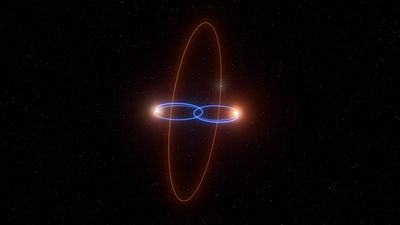


In 2018, astronomers discovered a brown dwarf binary system. Brown dwarfs are stellar objects that never had enough mass to fuse hydrogen and become fully fledged stars. They are often found in binaries, but this one was only the second eclipsing binary system discovered with both members being brown dwarfs. But there is something odd about the motion of this rare pair, and further analysis has brought forth a very unusual candidate. Researchers believe that pair 2M1510 is orbited by a planet in a "polar", or perpendicular, orbit. This is the first time we've seen strong evidence for a stellar pair being orbited by a polar planet.
"Polar orbit" means that instead of orbiting in the same plane as where the two stellar objects are located, the planet’s orbit is 90 degrees to that plane, as you can see in the image above. This configuration has been deemed theoretically possible, but actually seeing evidence for a planet orbiting like that is a whole other affair.
It is a really exciting thing to be a part of finding evidence of various different kinds of solar systems in weird, wacky configurations.
Thomas Baycroft
“The orbits of the brown dwarfs are eccentric. They're on elliptical orbits. What we found is that the ellipse is moving, so it's precessing in time, so it's changing its orientation,” lead author Thomas Baycroft, a graduate researcher at the University of Birmingham, told IFLScience.
“That is an effect that is known to happen. Mercury's precession was a test of general relativity back in the early 20th century. In the case of Mercury, the precession is positive or prograde: it's in the same direction as the orbit. Whereas in this case it's retrograde, backwards.”
A positive precession can be caused by an object on roughly the same plane, but if the object's orbit was strongly misaligned or even perpendicular, then it would cause this negative precession. Hence, the proposal of the existence of a planet without having seen it.
“It's pretty exciting,” Baycroft told IFLScience. “I mostly just hope it's real.”
Planets around binary stars were first predicted by science fiction before it became science reality. The universe is really interesting and there's lots of stuff going on!
Thomas Baycroft
So if the planet is indeed there, how did it end up in a polar orbit? It is possible for planetary disks to be located in that configuration, especially if the planet is big. The brown dwarfs weigh 35 times the mass of Jupiter, so the candidate would be a gas giant planet. A smaller planet might instead have migrated there from a slightly misaligned orbit to the polar one, especially if there was a third brown dwarf (currently undetected) in the system.
The correct scenario is uncertain because the current analysis doesn’t allow the team to work out the properties of the planet. However, they plan to continue following up on this system, with the goal of catching another eclipse (when one brown dwarf passes in front of the other), which will allow them to get better orbital data. It might be possible to get some insights from the recently ended Gaia data, which has accurate measurements of billions of objects in the galaxy.
“It is a really exciting thing to be a part of finding evidence of various different kinds of solar systems in weird, wacky configurations,” Baycroft told IFLScience.
“The planetary systems and star systems outside the Solar System can come in all kinds of configurations and sizes. You know, planets around binary stars were first predicted by science fiction before it became science reality. The universe is really interesting and there's lots of stuff going on!”
A paper describing the results is published in the journal Science Advances.


 1
1