Space and Physics
 PUBLISHED




What you'll discover in this article
- A newly discovered rocky exoplanet has the mass of 23 Earths but is only 2.5 times bigger than our planet.
- This is challenging our understanding of planet formation in many ways and places it in the rare category of "mega-Earth".
- GJ 523b is finally enough to confirm "mega-Earths" as a real category, co-author Dr Thomas Beatty told IFLScience.
Aplanet has been found defying normal categorization by having a mass 23 times that of the Earth, but little to no surrounding gas. The oddity does not end there. The new "mega-Earth" has an orbit taking the planet almost over its star’s poles, while lacking any signs of the usual explanation for such a plane.
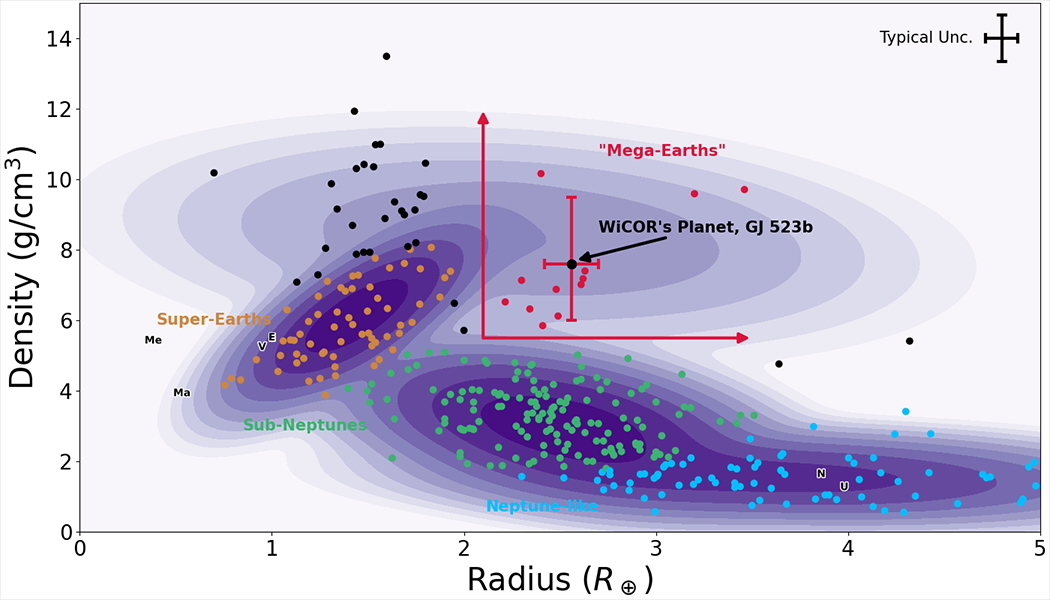
Now that we’ve discovered more than 6,000 exoplanets (planets orbiting other stars), one of the things we have learned is that a great many of them are between Earth and Neptune in size. Most fall into two familiar categories: “Super-Earths", with radii up to double that of our home planet and similar or greater density, and sub-Neptunes, which are larger, but have a cocoon of gas that drastically reduces their density.
There are also plenty of examples where we know the size or the mass, but not both, and therefore can’t measure the density. Nevertheless, astronomers usually expect these to fall into one category or the other with more measurements.
In contrast, a tiny number of planets with radii more than double Earth’s have been found, which are nevertheless even denser, indicating an enormous metal core without much around it. Slap bang in the middle of that part of a radius-density graph is newly discovered exoplanet GJ 523b, with a radius 2.5 times that of Earth, but about 23 times the mass, making it around 50 percent denser than our home.
Mega-Earths are weird
What have been called “mega-Earths” are a puzzle, because we expect a planet with such a massive core to capture plenty of hydrogen that would escape a smaller world’s light gravity, turning it into a sub-Neptune.
Some mega-Earths orbit so close to their stars that it is suspected the hydrogen got so hot it escaped. However, that explanation doesn’t really fit for GJ 523b. Its orbit is just 17.8 days, but GJ 523 is a K-type star, so the planet is warmer than Earth, but nothing like the hot Jupiters that dominated early exoplanet discovery and have held onto their gas under much more challenging conditions.
Moreover, a team led by graduate student Max Kroft and Dr Thomas Beatty of the University of Wisconsin-Madison found that GJ 523 is part of a group of stars that formed 170 million years ago, leaving little time for atmosphere stripping.
GJ 523b is also in an almost polar orbit, rather than orbiting in a plane nearly aligned with its star’s equator like the overwhelming majority of planets. Such orbits usually occur in systems with even larger planets, whose gravity probably scattered the smaller object into a polar orbit.
It’s possible GJ 523b has a big sibling, but we have yet to find it.
Finding the anomaly
GJ 523b was discovered after the TESS space telescope observed dips in the brightness of GJ 523 every 17.8 days, and Kroft followed up to see if the star was wobbling on a similar cycle under the influence of gravity.
TESS has been finding potential planets faster than astronomers can check if they’re real, so a lot of choice goes into which ones to verify. Kroft was actually on the hunt for hycean exoplanets, those popularly known as water worlds for being mostly ocean.
“We picked out this planet based on what we thought its size and temperature were,” Kroft said in a statement.
“A bigger planet makes a bigger dip, so we get an idea of the size, and based on how often that dip happens, we get the distance of its orbit, and we can use that to estimate the temperature of the exoplanet.”
Instead, they found something far too dense to have much water. “Dense planets like this aren’t uncommon,” Kroft said, “But they’re usually small rocky planets similar to Earth or Mercury. This planet is two and a half times bigger than the Earth.”
Creating a new category
The work at least helps astronomers confirm that mega-Earths are real.
“Any single planet with a strange mass could be a fluke, and the original mega-Earth, Kepler-10c, turned out to be one: its high mass didn't survive reanalysis,” Beatty told IFLScience.
“But over the past decade the sample has grown to 13 of these worlds, and that's finally enough to do statistics on," he said.
"Max ran a clustering analysis across the whole population of small planets, and these 13 fall outside both of the familiar exoplanet groups: they're too large to sit with the super-Earths, and too dense to sit with the sub-Neptunes. So, we didn't invent a definition and sort planets into it; the planets sorted themselves, and our job was to write down where the boundaries fell. GJ 523b is what pushed the sample over that threshold.”
Why so dense?
One possible explanation Kroft, Beaty and co-authors offer for the extreme density is that GJ 523b once orbited much closer to its star, becoming so hot it lost its hydrogen. We don’t know what would cause it to move out, rather than spiral further in, however.
Another possibility is that two planets with multi-Earth masses collided. Not only would each of them have previously retained less gas than a combined body, but the heat of impact would have let a lot of their hydrogen escape.
Unfortunately, we’re unlikely to find out a lot about GJ 523b’s history directly, although it’s possible more observations of the system might reveal an interfering larger planet that explains its orbit.
The team thinks that if such a planet exists, it will orbit at a steep angle to GJ 523b. Kroft told IFLScience, “A planet in a different plane would almost certainly not be transiting. Whether or not we can detect it is a bit dependent on how big it is, how long its orbital period is, and how inclined its orbit is relative to our line of sight.”
Fortunately, radial velocity observations will probably find it if continued for long enough. Kroft also has hopes the next release of data from the Gaia telescope will reveal movements in the star larger enough to confirm the effects of a giant planet.
However, Kroft hopes we might resolve the mystery by finding more planets like this one.
“It’s hard to infer things about planet formation in general from a sample size of one,” Kroft said. “We’re not going to get to 10,000 of these over-dense planets, but if we can get to 20 or 30, maybe some trends might pop out, where maybe the heaviest ones have shorter orbital periods, or they tend not to have companion planets.”