


 Space and Physics
 PUBLISHED



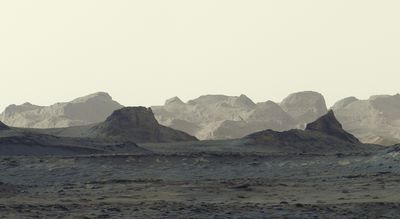


Pictures taken by our robotic explorers on Mars are always striking, especially when we allow ourselves to truly appreciate that they come from a whole other planet. The latest image shared by NASA's Curiosity team makes for a beautiful and unearthly example; it is dawn on a different world.
The images are crisp and, to this reporter's eye, almost look like a painting.
Just like on Earth, the colors on Mars are different at dawn compared with during the day, so to preserve the actual early morning appearance, the team processed the photographs without white balancing. This better reflects how the scene looks on Mars, compared with how it would look if the same surfaces were photographed under Earth lighting conditions.

While earthly dawns are tinged in pinks and reds, the ones on Mars are white and blue. The reason is similar to why our sky is blue and our sunsets are red. But on the Red Planet, this is flipped.
You may remember that although light from the Sun appears white, it is actually made of a combination of different wavelengths (or colors). Molecules and dust particles in the air interact with specific wavelengths of sunlight in different ways, deflecting them by different angles and creating a tint of whatever color gets "scattered" the most.
On Earth, blue light is scattered most during the day, while the lower angle of the sun at dawn and dusk produces a red hue. The Martian atmosphere, however, is very different from Earth's. It is a lot more tenuous, just 1 percent of Earth’s own – which is like being at a 30-kilometer (18-mile) altitude.
It is also almost exclusively made of carbon dioxide, with a lot of dust for good measure. These changes end up scattering red light more than blue, so light on the planet appears reddish throughout the day. At sunrise and sunset, however, light has a longer distance to travel, and what remains is the blue-white light that gives this image its otherworldly character.
The image was taken on August 11, the 4,982nd Martian day, or sol, of the mission, and just one week after Curiosity's 14th Martian birthday (sadly, the rover doesn’t sing itself "Happy Birthday" anymore). The full picture is made of six images stitched together.
What in the world is a yardang?
The wind-carved crags visible in the image are called yardangs. Mount Sharp and Gale Crater, where Curiosity is located, is made of sedimentary deposits from the time the region is thought to have been a lake. Once the water left, the wind exposed different layers, which the rover is exploring.
The yardang layer is particularly exciting because, for a number of reasons, it is a bit odd.
“The yardang layer looks out of place. It’s the wrong color, the layers tilt at an odd angle, and it almost appears plastered on,” Ashwin Vasavada, Curiosity project scientist at NASA’s Jet Propulsion Laboratory, said in a statement.
“But that’s what makes it exciting to reach. No one is sure exactly what created this layer, but one idea is it may be ash deposited by ancient volcanic eruptions.”
Curiosity has recently broken a record by getting to 1 kilometer (0.6 miles) of elevation; that’s the highest climb ever done on Mars. Good going little guy.



 1
1