Space and Physics
 PUBLISHED




An ambitious project to map the density of every object in the cosmos has yielded a few surprises, and may help lead to new insights on some of the strangest bodies in the universe.
First up, what objects are we talking about? The team of astronomers from the University of Idaho were interested in "cohesive objects", or objects that have relatively well-defined surfaces, such as asteroids, comets, planets, and stars, rather than objects more loosely held together like galaxies and nebulae. This includes, perhaps controversially, black holes, with the "surface" in this case being the event horizon, the point beyond which the gravitational pull is so strong not even light, traveling as it does at ridiculous speed, can escape.
This is a pretty wide range of astronomical objects, with a variety of formation processes in play. For example, stars are thought to form via a rapid gravitational collapse of gigantic molecular clouds, whilst planets are thought to form by slower accretion of material around a newly-formed star. Then there are compact objects like white dwarfs, neutron stars, and black holes, the dense remnants left behind at the end of the lives of various different types and sizes of stars.
In the new work, the team took a sample of 2,157 astronomical objects, carefully selected for having reliable measurements of both mass and radius, from which you can work out their density. They then plotted these objects on a graph, revealing how they compare in terms of density and mass, with the gray dotted line representing the Schwarzschild black hole event horizon.
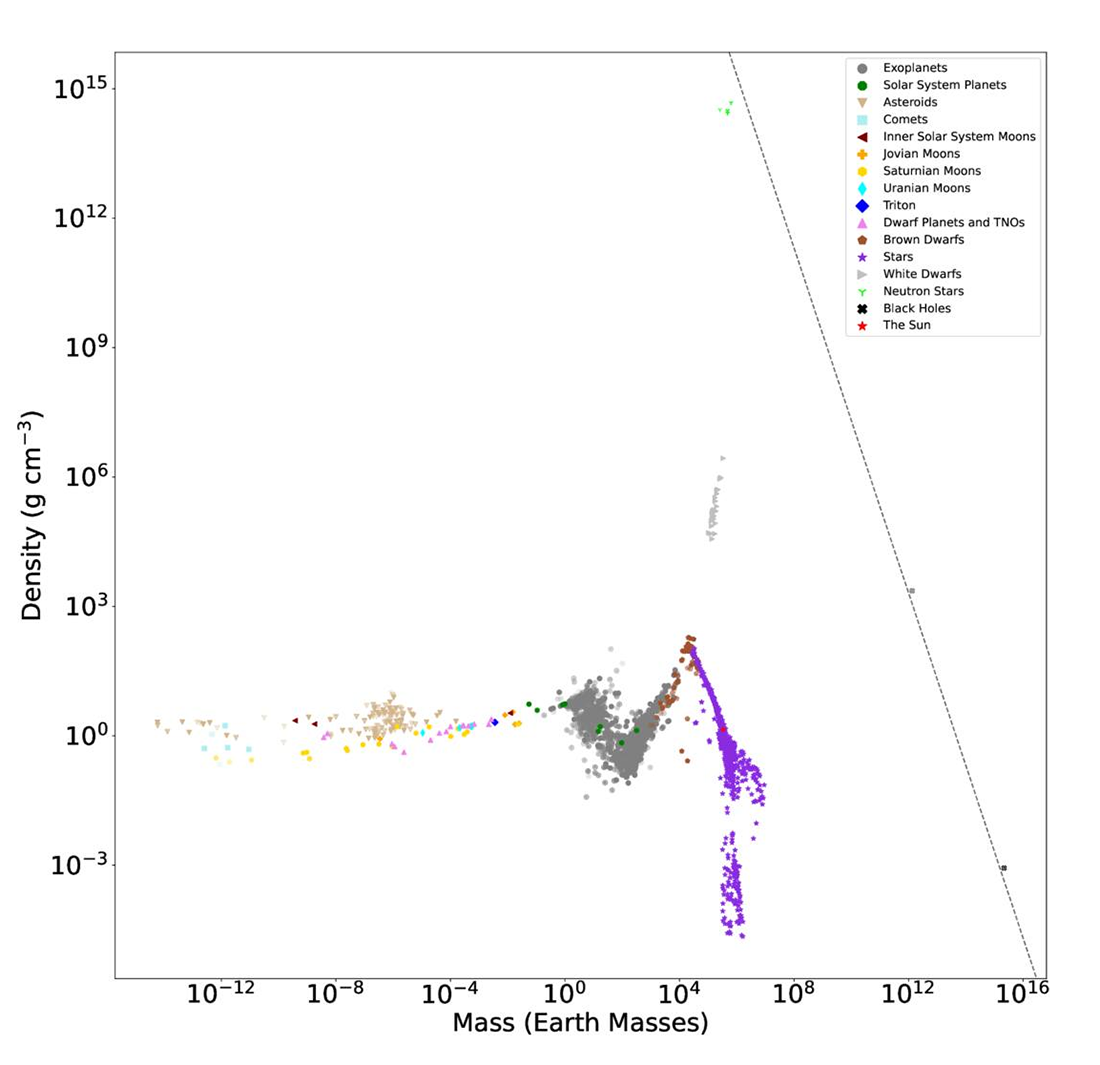
"The most remarkable aspect of [the graph] is that it showcases an unbroken progression from the smallest asteroids to the largest stars, spanning most other kinds of astronomical objects over 12 orders of magnitude in mass when disregarding the black holes, as that region is undersampled," the team explains in their paper.
"We call this progression the 'cohesive object sequence,' after the stellar main sequence, which it contains. Of the objects considered here, only compact stellar remnants, giant stars, and certain actively collapsing bodies clearly lie off the cohesive object sequence."
That might be quite surprising. Despite different formation processes, most objects out there fall along quite a narrow sequence, with the exception of objects such as dense neutron stars and white dwarfs.
"One might be tempted to describe the cohesive object sequence as a representation of how objects develop as they accrete more mass, but such an interpretation would be inconsistent with how these objects actually form," the team adds, explaining that the chart provides insight into equilibrium processes, rather than formation processes themselves.
One interesting aspect of the research is the distinction it shows between different types of planets and small bodies. In terms of density, there is a lot of overlap between rocky planets, dwarf planets, and asteroids. At around 100 Earth masses, however, there is a clear distinction in density.
"At this location, not only does density start increasing with mass again, but also the variations in density begin to become narrower," the team explains. "This dramatic change in behavior marks the transition between volatile-rich worlds with a range of compositions and the gas giants composed primarily of hydrogen and helium, like Saturn and Jupiter."
According to the team, Saturn sits neatly in the middle of this feature, suggesting to them that it may be one of the smallest gas giants possible.
A particularly intriguing finding regards brown dwarfs, sub-stellar objects that are typically found to be between around 13 and 75 times the mass of Jupiter. Brown dwarfs are thought to form as stars do, though they do not have enough mass to begin fusing hydrogen into helium at their core, able only to fuse deuterium (heavy hydrogen) for a short time. For this reason, they are often labeled as "failed stars". And yet, looking at their density and comparing it to gas giants, thought to form via accretion around a host star, the team found little distinction between the two types of objects in terms of density.
"No matter which parameters are plotted, there is no obvious feature in the sequence that can serve to clearly define the boundary between gas giants and brown dwarfs," the team writes, adding that they see no indications of major changes at the deuterium burning limit.
"Our plot shows a paucity of mid-range brown dwarfs (at around 2 × 10⁴ Earth masses). It is unclear if this is due to an observation bias, or if mid-range brown dwarfs are truly uncommon. The brown dwarfs that do exist in this region preclude it from being used as an easy delineator between gas giants and brown dwarfs, however."
While the paper found that certain astronomical objects blur quite nicely with each other, there are also extreme outliers in white dwarfs, neutron stars, and black holes, with these objects being separated from the other objects by giant gaps in density.
"We can note that all of the compact objects—white dwarfs, neutron stars, and black holes—are also not on the cohesive object sequence, and the jarring lack of objects connecting these regimes to the sequence is indicative of the dramatic processes that form them," the researchers explain.
The study is published in Publications of the Astronomical Society of the Pacific.