Nature
 PUBLISHED


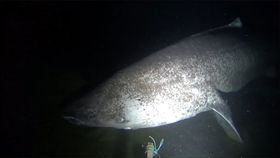


Canadian researchers have captured footage of a large number of Greenland sharks, one of the largest and longest-lived marine species in the world. The polar oceans have many secrets and these sharks are one of them.
As reported in Nature, the scientists set out to better understand the behavior of these animals. They deployed 31 underwater cameras in the Eastern Canadian Arctic during the summer of 2015 and 2016. In 250 hours of footage, they identified 142 individual Greenland sharks and collected important data.
“The recordings gave us valuable insight into their abundance, size, and behavior, as well as their distribution in the Canadian Arctic," two of the authors wrote in a piece for The Conversation. "These findings are the first step towards closing a major knowledge gap on the population status of the Greenland shark. And we did it without taking any sharks from the water."
Greenland sharks can live for centuries, with estimates suggesting that their lifespan can reach up to around 400 years. They are blind due to an eye parasite and they swim really slowly, probably the slowest shark in the world, but they are fearsome predators. They are even capable of hunting seals despite the sea mammals being much faster. It is not exactly clear how they do it, but studies like this will help researchers better understand these creatures.
“Their evasiveness highlights how little we know about Arctic marine ecosystems – and how much we can learn by developing and employing new technologies,” the authors write. “At a time when oceans are rapidly warming, Arctic sea-ice cover is shrinking and there is increasing interest in Arctic fisheries and conservation, it’s important that we understand the domains of these large, ancient creatures.”
Check out their amazing footage below.