Nature
 PUBLISHED






In the small hours of February 24, 1979, the town of Randolph in Utah was rocked by an earthquake. Or was it? Geologists registered the shake-up on their seismograms – a small but ample magnitude 3.8 – yet no one on the ground felt the tremor.
Data suggested the activity originated around 90 kilometers (55 miles) below sea level, but this was far, far deeper than had been thought possible. Scientists were taken aback, but thanks to a string of similar occurrences in the decades that followed, they now have a compelling explanation.
The biggest clue came on September 10, 2025, when an equally elusive quake struck at Utah’s Uinta Basin, clocking in at magnitude 4.1. Researchers from the University of Utah studied the seismic data and found the depth of the activity was 68 kilometers (42 miles) below the surface.
Just like the 1979 quake, this isn't where you’d expect to find an earthquake. Both originated more than 20 kilometers (12 miles) below the Mohorovičić discontinuity, AKA the Moho point, the seismic boundary separating Earth's hard crust from the softer mantle beneath.
Until recently, earthquakes were thought to only echo through the crust above the Moho point. Below it, the mantle rock was considered too squishy to accumulate the elastic tension a quake requires; rather than snapping and shaking, it slowly deforms and goes with the flow.
When researchers examined records, they identified a cluster of comparable events beneath northern Utah and southwestern Wyoming, all originating deep underground and barely leaving a trace on the surface.
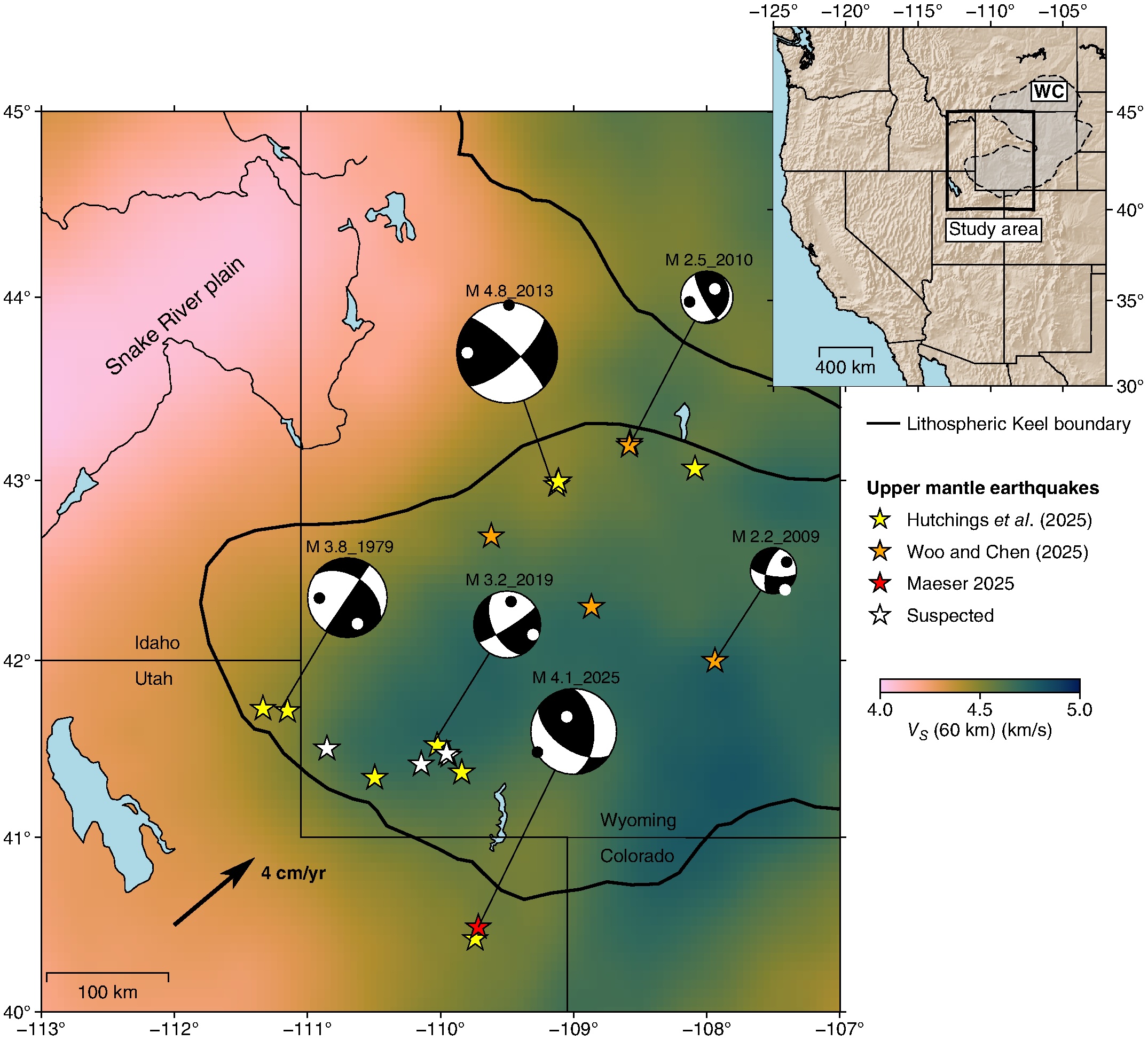
In a new study, the team from the University of Utah says these are likely to be a relatively new class of geophysical phenomena known as continental mantle earthquakes.
Scientists had long speculated that such events in the upper mantle were possible, although their existence was met by some skepticism. In recent years, however, geologists have documented more than 450 continental mantle earthquakes that have unfolded since 1990.
“The deep depth explained why it wasn’t felt by people at the surface,” George Zand, an expert of geophysics at the University of Arizona, who gathered the original data of the 1979 quake, said in a statement.
“I did some other analysis that convinced me of the reality of the deep depth but it was hard to convince others of the highly anomalous mantle earthquake occurring in a region where none should exist.”
Unlike typical earthquakes, which occur near subduction zones and can be explained by the movement of tectonic plates, the old rules don’t apply to continental mantle earthquakes.
The next conundrum was why so many of these rare earthquakes occurred in this part of the US. The researchers argue it has something to do with the Wyoming Craton, an ancient slab of continental crust that has remained largely intact through the millions of years of geological upheaval and tectonic movement.
The craton sits at the boundary between the geologically restless western US and the much more stable interior of the North American plate. Over millions of years, it has been worn down and thinned, gently drifting westward across Idaho and Utah. It is precisely here, the researchers say, where the deep earthquakes have been occurring, which is unlikely to be a coincidence.
“On the scale of millions of years, the mantle is hitting the craton and then flowing around it,” explained Keith Koper, lead study author and geologist at the University of Utah.
“It's that interaction where that mantle flow is being diverted around this hard cratonic root that's causing the increased strain rate, the increased deformation and it's also creating extra stresses. We think it's that interaction between the keel of the iceberg and the medium around it that's leading to these earthquakes.”
The 2025 shake-up beneath Utah has been described by the researchers as an “archetypal” continental mantle event. As geologists continue to piece together this phenomenon, events like this could prove very helpful to them.
The new study is published in the journal The Seismic Record.