Nature
 PUBLISHED
 2
2


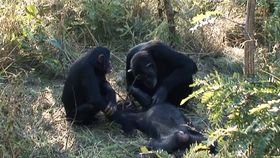


Biologists have documented the bizarrely intimate behavior of a chimp using a tool to clean the teeth of a corpse group member (video below). Not only does this provide researchers with further insight into the emotional intelligence of apes, but it could shed light on the evolutionary origins of humans ritualizing death.
Scientists from the University of St Andrews in Scotland captured the behavior for the first time at Chimfunshi Wildlife Orphanage Trust in Zambia. They watched as Noel, a wild-born female chimpanzee, came across the dead body of her adopted son Thomas. Their study in Nature Scientific Reports details how she approaches him and sits down beside his head almost immediately after seeing the body. She then selects a blade of hard grass from the ground, opens Thomas’ mouth, and appears to clean his teeth with the grass.
The behavior is all the more strange because the researchers note they had not seen any of the chimps at Chimfunshi perform tool-assisted teeth cleaning during their 8,000 hours of observation.
“Death responses represent core features of human civilization with great diversity in mortuary rites found across cultures,” the study authors note. “We present a valid case of unique non-human animal behavior which could shed light on the evolution of behaviors that are believed to be typically human.”
However, Professor Klaus Zuberbuehler, who wasn’t involved in the study, is cautious to stretch the conclusion too far. It's possible the chimpanzee is actually just challenged by the death of a group member becoming suddenly motionless.
Thibaud Gruber of the University of Geneva told New Scientist: “We simply do not know if and how much chimps understand about death. In other words, it is unclear whether this is ‘corpse cleaning’, or simply ‘social cleaning’. But certainly, it adds on behavioral descriptions of unusual behavior displayed by chimps when they face the death of one of their species.”