Space and Physics
 PUBLISHED
 3
3



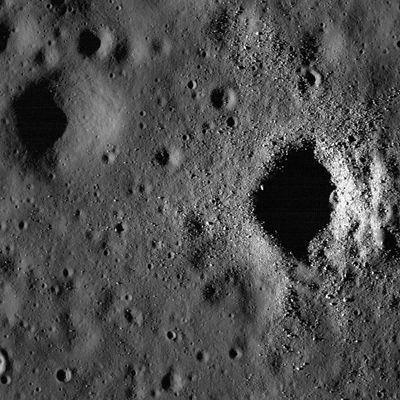


Back in December 2020, Chang’e-5 flew to the Moon, landed, collected rocks, and brought them back to Earth. This was the first collection of lunar material in 45 years and it is delivering fascinating insights into the composition and history of the Moon.
The samples have once again confirmed the presence of water on the Moon as well as finding rust in the surface rocks. The latest work looked at high-pressure minerals, those formed as a consequence of asteroid or cometary impacts. As we can see with our naked eye, the Moon is covered in craters but in samples collected during the Apollo years and by the Soviets, these minerals are lacking.
In the sample, the team discovered a new phosphate mineral they are calling Changesite-(Y), the first new lunar mineral from the sample collected by the Chinese probe. They believed it formed late in the crystallization stage of basalts found in the region where Chang’e-5 landed. It is transparent and colorless and it is made of column-shaped crystals.
If this discovery was not exciting enough, the team found two known shock minerals: stishovite and seifertite. These are silica polymorphs and have the same composition as the regular quartz you might have seen around, but they have a dramatically different crystalline structure due to their formation at high pressures and temperatures.
"Although the lunar surface is covered by tens of thousands of impact craters, high-pressure minerals are uncommon in lunar samples," author Wei Du, from the Chinese Academy of Sciences, said in a press statement. "One of the possible explanations for this is that most high-pressure minerals are unstable at high temperatures. Therefore, those formed during impact could have experienced a retrograde process."
A specific sample gave them important insights into this process. They found both stishovite and seifertite in the same sample, and these minerals only exist together at higher pressures. For this reason, the team suggested that maybe the minerals change shape from one to the other in changing conditions.
They believe that a third identified silica polymorph (α-cristobalite) is the original product from which both shock minerals are formed.
"In other words, seifertite could form from α-cristobalite during the compressing process, and some of the sample transformed to stishovite during the subsequent temperature-increasing process," said Du.
The samples are believed to have come from the Aristarchus crater not too far from Oceanus Procellarum where the probe landed. The ejecta from the collision landed where Chang’e-5 found them.
A paper describing the results is published in the journal Matter and Radiation at Extremes.