Humans
 PUBLISHED




Going to the dentist has never been fun, but imagine how rough it must have been in the era before anaesthetics, handwashing, and shiny, sterile equipment. Go one step further, and picture having your tooth drilled in a cave by a Neanderthal nearly 60,000 years ago.
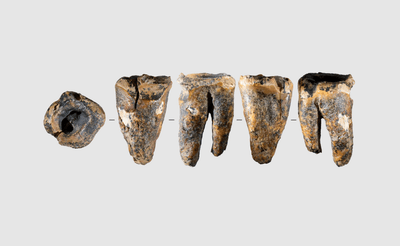
Incredibly, archaeologists have just discovered evidence of this at Chagyrskaya Cave in Russia. Here, researchers from the Russian Academy of Sciences unearthed the molar of a Neanderthal, dated to 59,000 years old, with a deep hole in its center.
The tooth appeared to have been drilled, much like how modern dentists do it, but how would a prehistoric Neanderthal achieve this surgical feat? To find out, the team recreated the event in their lab by drilling into a real human tooth with a prehistoric-style stone tool.
“To interpret the concavity on the occlusal surface of the tooth, we conducted experimental manual drilling on a series of specimens: a modern human tooth and two Homo sapiens teeth from a Holocene archaeological collection of uncertain temporal and cultural provenance,” Lydia Zotkina, study author from the Russian Academy of Sciences, said in a statement.
By comparing Neanderthal molars to the results of their experiment, the researchers “revealed a clear match,” said Zotkina. “The findings demonstrate that drilling a carious lesion using a sharp, thin stone tool is entirely effective, permitting the rapid removal of damaged dental tissue.”
Chagyrskaya Cave is located in the Altai Mountains of southern Siberia, the same region where the famous Denisova Cave revealed the presence of a new human species, the Denisovans, as well as other Neanderthal remains. It’s been speculated that many of these prehistoric populations in this part of the world are connected and genetically related, although researchers are still piecing together exactly how they are all interlinked.
“Neanderthals arrived in this region 70–60 thousand years ago during a migration from Central and Eastern Europe and inhabited it until at least 40–45 thousand years ago. Altai became a new and suitable home for them thanks to its biological diversity, climate similar to that of Europe, abundant raw materials for stone tool production, and their usual prey – wild bison and horses," said Ksenia Kolobova, an archaeologist at the Russian Academy of Sciences.
"Analysis of stone tool industries and paleogenetic studies have shown that the Neanderthals from Chagyrskaya Cave are very closely related to the bearers of the so-called Micoquian industry, who also lived in the Caucasus and Crimea," noted Kolobova. Last year, 42,000-year-old yellow crayons found at a Middle Paleolithic Micoquian site in Crimea added to evidence that Neanderthals created art.
The recently discovered tooth is the first time complex dental work has been seen outside of Homo sapiens. Before this discovery, the oldest archeological evidence of dentistry came from a 14,000-year-old tooth found in a rock shelter in Belluno, Italy. That means this tooth pushes back the history of dental work by some 40,000 years.
“This finding currently represents the world's oldest evidence of successful dental treatment," the authors write. "The damage documented on the Neanderthal tooth from Chagyrskaya Cave in Siberia points not only to intentional pulp removal but also to antemortem wear – wear that could only have developed if the individual kept using the tooth while alive. We also identified areas of demineralisation where remnants of carious damage were preserved, further indicating that the concavity in the tooth was associated with treatment."
This tooth operation, of course, would have been a horrendous ordeal. However, the researchers speculate that the Neanderthals knew that removing the infected tissue was perhaps a life-saving move.
The latest discovery is yet another reminder that Neanderthals are far from the knuckle-dragging, boneheaded brutes they were once portrayed as. A stream of recent research has shown this extinct human species created artworks and jewelry, honoured the dead with ceremonies, and perhaps held spiritual beliefs.
Apparently, they were also pioneers of dentistry.
The study is published in the journal PLOS ONE.

 2
2