Space and Physics
 PUBLISHED
 3
3


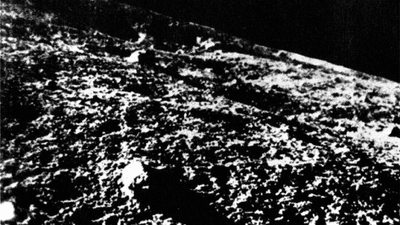


Astronomers believe they may have found the final resting place of Luna 9, the Soviet spacecraft missing since it landed on the Moon on February 3, 1966.
On January 31, 1966, the Soviet Union launched Luna 9 using a Molniya-M rocket. Before Luna 9, other probes had landed on the surface of the Moon, with Luna 2 the first probe to impact the lunar surface. But Luna 9 became the first mission in history to make a soft landing on another celestial body. As it approached the surface, Luna 9 released a landing capsule, before maneuvering away from the site of the drop to crash into the lunar surface in peace.
The landing capsule itself bounced several times before coming to a rest and opening up four petal-like panels in order to keep itself steady. Then, using a TV camera and a revolving mirror system, the probe began to take and send back the first-ever images taken from the surface of a rock that wasn't Earth. The probe was operational for three days before the batteries ran out, and it lost contact with scientists back on Earth. Though the mission did not involve a lot of scientific experiments, we learned a lot from the excursion.
"It was the first ever soft landing on another celestial body," the European Space Agency (ESA) explains. "It opened the way for manned trips to the Moon, by removing doubts that the surface was unsafe quicksand."
After the landing, the Soviet Union published the estimated coordinates of the Luna 9 landing site in the Soviet newspaper Pravda. However, due to uncertainty in the calculations, the probe could be tens of kilometers from the published coordinates. In the intervening years, we have gotten a much better look at the lunar surface, but have failed to spot this piece of spaceflight history.
"The Lunar Reconnaissance Orbiter Camera (LROC) Narrow Angle Camera has imaged the Moon continuously since 2009, providing a unique record of both natural and anthropogenic surface features at up to 0.25 m pixel⁻¹ resolution," the new team explains in their study. "Identifying artificial objects within the resulting vast dataset remains a challenge owing to illumination variability, complex backgrounds, and the small pixel footprints of many targets."
The team aimed to correct this, training a machine-learning algorithm dubbed "You-Only-Look-Once—Extraterrestrial Artifact" (YOLO-ETA) to search LROC data for signs of human-made lunar landers. Once trained, the algorithm was presented with images it hadn't seen before of known landing sites, and was able to identify them as landing sites with high confidence. This included the later Luna 16 lander.
After this, the team set YOLO-ETA to work looking for the Luna 9 probe. Though the find is far from definitive, the team believes they have identified the possible resting place of the spacecraft.
"When applied to the long-standing problem of locating the Luna 9 spacecraft, the model detected a cluster of candidate artefacts near 7.03° N, –64.33° E that meet several independent plausibility tests: recurrence under different illumination geometries, spatial separations compatible with the expected dispersal of mission components, and local topography consistent with the flat horizon recorded in Luna 9’s surface panoramas," the team writes. "These results do not constitute definitive proof of the lander’s recovery, but they identify a credible site for targeted re-imaging."
Targeted re-imaging from LROC or future orbiters is recommended to see if Luna 9 has been found.
"Regardless of the outcome, this work establishes that compact deep-learning architectures such as YOLO-ETA can extend beyond Earth orbit," the team concludes, "enabling systematic surveys of the Moon’s technological artefacts and supporting the responsible exploration of our nearest celestial neighbour."
The study is published in npj Space Exploration.