Space and Physics
 PUBLISHED
 1
1


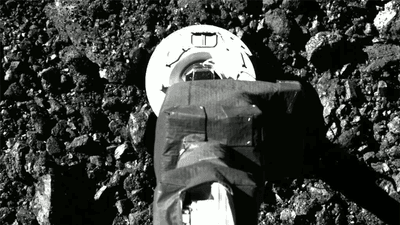


In late September, NASA successfully returned a sample of asteroid Bennu to Earth. Since then, they have begun the painstaking and delicate process of opening the sample, which the team had spent months rehearsing.
Unfortunately, the team then hit a small snag: two of the 35 fasteners on the Touch-and-Go Sample Acquisition Mechanism (TAGSAM) were stuck, preventing them from accessing the bulk of the sample. That problem is ongoing, with NASA currently working on creating a screwdriver that can fit and function inside the "glovebox", a chamber that flows nitrogen in order to keep the samples pristine and free from contamination by our own atmosphere.
“It’s kind of like Schrödinger’s sample," Dante Lauretta, a planetary scientist at the University of Arizona in Tucson who heads scientific analysis for OSIRIS-REx, told Nature of the sample trapped inside the TAGSAM. “We don’t know what’s in there.”
NASA has been able to access a lot of material from Bennu from outside the sampler head, however, and some from inside the sampler head: 70.3 grams (2.5 ounces) to be exact, with NASA expecting there to be around 120 grams (4.2 ounces) in total. NASA is beginning to talk about what they've found out about these samples so far, and some of it has left researchers a little puzzled.
Early analysis of the samples shows that they are rich in elements present at the birth of the Solar System, over 4.5 billion years ago. As well as this, they appear to be rich in organic compounds and water in hydrated mineral form.
Both these finds are exciting, with research suggesting that asteroids deliver water to terrestrial planets, and asteroids potentially delivering the building blocks of life to Earth billions of years ago. Researchers are now looking for amino acids in the samples, the building blocks themselves.
What's puzzled scientists so far is smaller chunks within the sample that appear to have a light-colored, reflective coating. Breaking this brittle layer apart easily revealed darker material underneath. Chemical analysis of this outer layer showed that it contained magnesium, sodium, and phosphate, which Lauretta told Nature was a "head-scratcher right now" as these elements are rarely, if ever, seen in meteorites.
Of course, other than a few small (and scientifically astonishing) samples from Japanese missions, we have never had pristine examples of asteroids before, undamaged from hurtling through Earth's atmosphere.
For now, we will have to wait for the detailed results from a complex mission that brought back an asteroid sample to Earth, and a screwdriver.
"There will be some exciting, detailed organic molecular results coming soon," Lauretta told BBC News. "But the team needs a bit more time to think about them because we need to make sure all the results are correct. This is so important, we don't want to make a mistake."