


 Space and Physics
 PUBLISHED


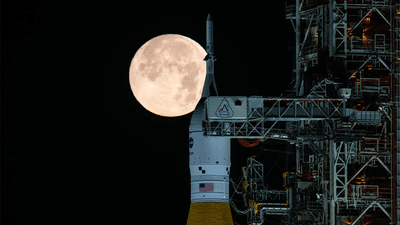


NASA has revealed the surprisingly sophisticated meals that astronauts will eat on their way around the Moon during the upcoming Artemis II mission.
Eating in space – prior to longer time spent in space on humanity's space stations – has generally been a pretty grim affair. Soviet cosmonaut Yuri Gagarin, the first human to venture into space, was also the first person to eat there. Humanity's first meal in space was a tube of beef and liver paste, with a chocolate sauce for pudding, which doesn't sound like the most appetizing meal, even if the restaurant is in the ideal location. The first NASA astronauts weren't exactly eating gourmet either.
"John Glenn, America’s first man to eat anything in the near-weightless environment of Earth orbit, found the task of eating fairly easy, but the menu limited," according to NASA.
"Other Mercury astronauts had to endure bite-sized cubes, freeze-dried powders and semi-liquids packaged in aluminum tubes. Most agreed the foods were unappetizing and disliked squeezing the tubes. Moreover, freeze-dried foods were hard to rehydrate and crumbs had to be prevented from fouling instruments."
The problem, of course, is a lack of equipment in space. As nice as it would be to pack a kitchen, or a Michelin-starred module, kitchens tend to come with a lot of mass.
"With no resupply, refrigeration, or late-load capability, all meals must be carefully selected to remain safe, shelf-stable, and easy to prepare and consume in NASA’s Orion spacecraft," NASA explains of the new menu. "Foods must be easy to prepare and consume in microgravity, minimize crumbs, and remain safe and stable throughout the mission."
Crumbs have been an issue before, with NASA noting that sandwiches proved "less than ideal" due to going stale, and crumbs floating away, potentially getting into sensitive equipment or even the astronauts' lungs.
For their upcoming missions, the Artemis II astronauts will be allowed to choose up to two flavored beverages per day. They can choose from coffee, green tea, mango peach smoothie, a chocolate breakfast drink, a vanilla breakfast drink, lemonade, apple cider, pineapple drink, cocoa, and a strawberry breakfast drink. Not a bad selection on the beverage front.
NASA listed the most common food items that will be taken on board the mission, having made it through testing by astronauts ahead of the mission. It appears that even in space, and with strict requirements on "no crumbs", there is still no escape from couscous.
Fifty-eight tortillas will be flying with the crew, as well as wheat flat bread. On the more exciting front, the crew will have access to barbequed beef brisket, macaroni cheese, broccoli au gratin, spiced green beans, and vegetable quiche. Couscous with nuts will also be on the menu, as well as blueberry granola and breakfast sausage.
They've even got five different types of hot sauce, mustard, jam, honey, peanut, and almond butter.
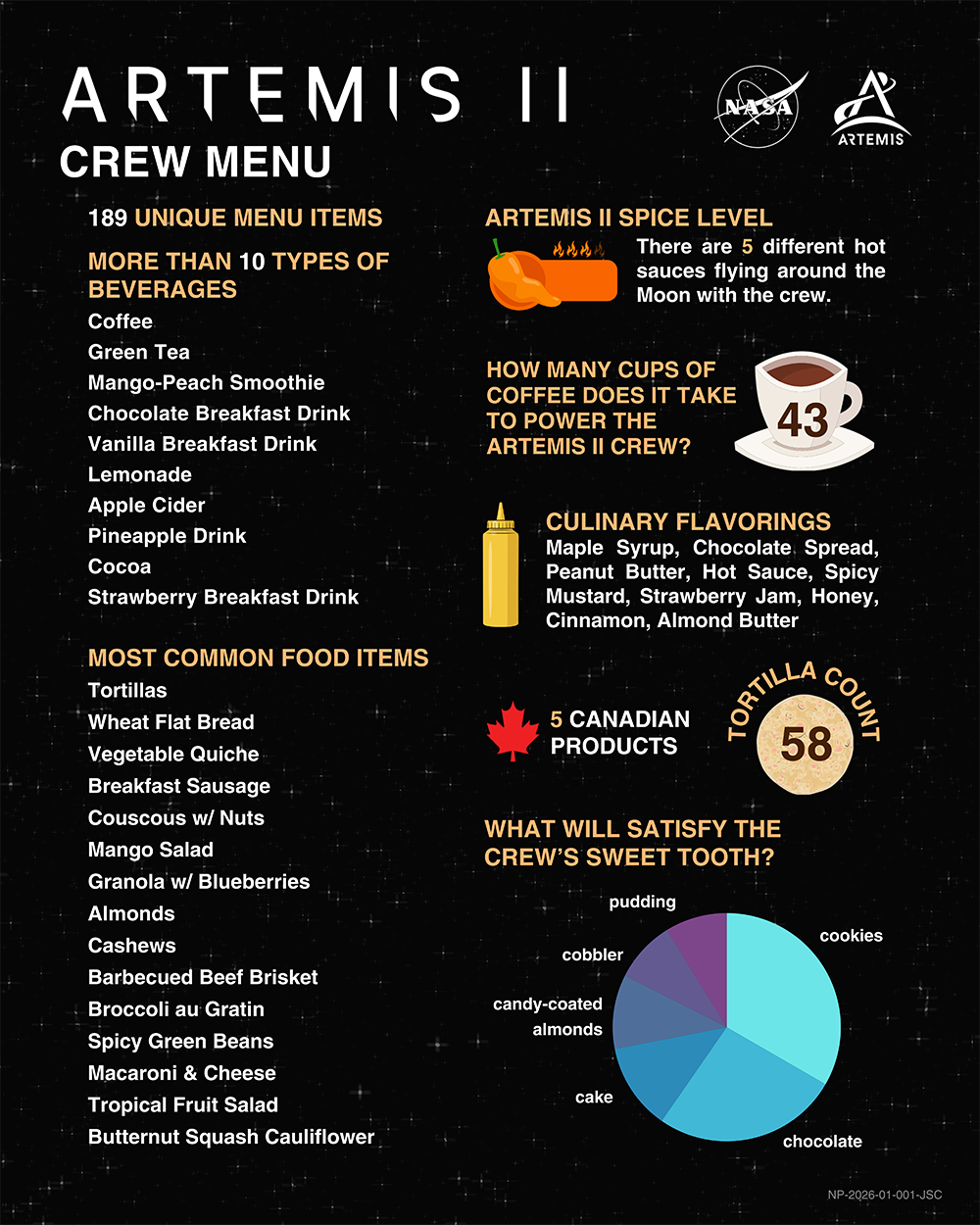
While the menu sure sounds better than tubes of meat paste, the requirements of the mission will limit what the crew can eat and when.
"Certain foods — such as freeze-dried meals — require hydration using Orion’s potable water dispenser, which is not available during some phases, including launch and landing," NASA explains. "As a result, foods selected for those phases must be ready-to-eat and compatible with the spacecraft’s operational constraints, while a broader range of food options are available once full food preparation systems are up and running."
Those systems include a briefcase-sized heater to warm up the food after it has been rehydrated. So, that's the menu sorted. What about the rest of the mission?
Last month, Artemis II's launch was delayed following a helium flow issue to the upper stage engine. Since then, NASA has been hard at work identifying the problem ahead of potential upcoming launch windows.
"Engineers determined a seal in the quick disconnect, through which helium flows from the ground systems to the rocket, was obstructing the pathway. The team removed the quick disconnect, reassembled the system, and began validating the repairs to the upper stage by running a reduced flow rate of helium through the mechanism to ensure the issue was resolved," NASA explained in an update.
"Work on the rocket and spacecraft will continue in the coming weeks as NASA prepares for rolling the rocket out to the launch pad again later this month ahead of a potential launch in April."
April 1, followed by 3-6 and 30, are the possible launch dates that will keep Artemis II on schedule. After that, there will be a rolling opportunity each month that will be shared if it comes to that.
Fingers crossed that it takes off, before NASA has to come up with a lighter, summery menu.



 1
1