


 Space and Physics
 PUBLISHED


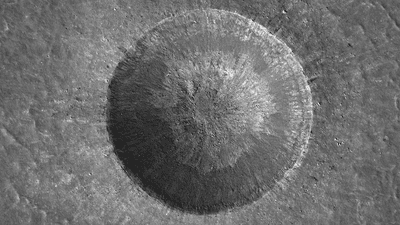


A team of scientists looking at images from NASA's Lunar Reconnaissance Orbiter Camera (LROC) have discovered a rare impact event on the Moon, leaving it with a crater so large that they are thought to only form roughly once every 136 years.
In 2009, NASA launched the Lunar Reconnaissance Orbiter, a spacecraft designed to image and map the surface of Earth's natural satellite. The orbiter takes continuous measurements of the lunar surface, including its composition and temperature, identifying resources like water and potential landing sites for crewed and uncrewed missions.
The orbiter has been in space for nearly 17 years now, the longest of any lunar-orbiting mission. An advantage of always having this spacecraft whizzing around the Moon is that we can see when anything changes on the lunar surface.
That doesn't happen too often. Though there are signs that the Moon may be more geologically active than we realized, the majority of changes to the lunar surface are the result of meteorites slamming into it, unprotected by a substantial atmosphere.
In a Lunar and Planetary Sciences Meeting taking place in Texas last week, astronomer Mark Robinson, principal investigator for the LROC, announced that his team had discovered a new crater whilst doing routine analysis comparing lunar images over time. The new crater, measuring 225 meters (738 feet) in diameter, is far larger than other craters discovered by the orbiter.
By analyzing the impact craters on the Moon and other bodies, and comparing them to the size of the impacted body, it is possible to figure out roughly how many impacts of this size should occur within a certain timescale.
"Prior to this discovery, the largest crater found to have formed during the LRO mission had a diameter of 70 m [230 feet]," the team explains in a paper presented at the conference. "According to the Neukum crater production function, a crater of this diameter should form every 139 years."
The crater has an average depth of around 43 meters (141 feet), and is surrounded by bright streaks of lunar ejecta, material thrown up following the impact event. According to the team, the new crater appeared sometime in the late spring of 2024, and this rare event allows scientists to compare models of lunar impacts to the real deal. On that front, models predicted that the size of ejected boulders of Moon rock would follow a power-law relation, with a maximum block size of around 4–12 meters (13–39 feet). This was consistent with what the team found, with the largest block identified measuring about 11 meters (36 feet).
While this is a new crater, as a result of the impact, the Moon's crater tally went down.
"Only two preexisting craters are detectable within two radii (4 and 8 m [13 and 26 feet] diameters), and both occur within 30 m [98 feet] of that limit," the team explains. "All other craters (maximum 40-m [131 feet] diameter) within that limit were obliterated or so degraded that they are no longer detectable under 38° incidence angle illumination, although future imaging may reveal more surviving craters."
"The loss of pre-existing craters out to about two crater radii from the rim and the distribution of the high reflectance material is consistent with continuous ejecta contained within two radii of the rim," they add, highlighting that this fits within previous model predictions.
As well as being cool to find a new crater-erasing crater on the Moon, the research highlights the value of having the Moon under constant surveillance.
"The fact that we have meter-scale before-and-after images of a 225-meter [738-foot] diameter crater provides a unique opportunity to test models of small-impact crater formation."
The work was presented at the 57th Lunar and Planetary Sciences Meeting, and the presented paper is available online.

 1
1